
Introduction
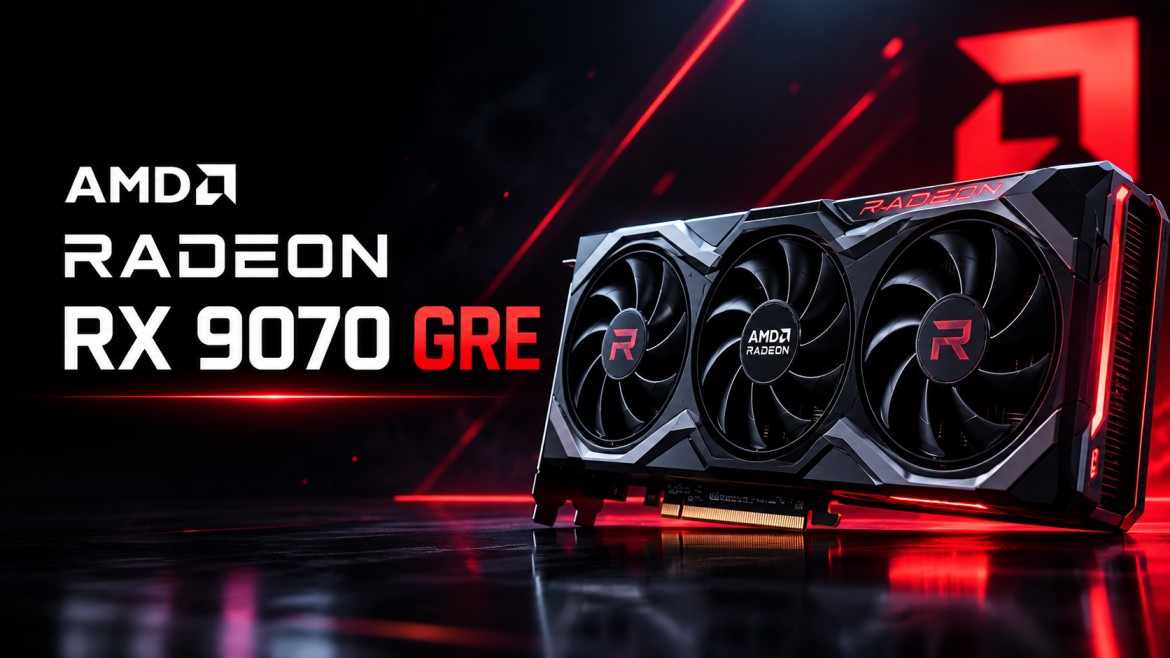
The mid-range GPU market in 2026 just got a serious shake-up. Fresh from Computex 2026 in Taipei, AMD has officially launched the Radeon RX 9070 GRE (Golden Rabbit Edition / Great Radeon Edition) globally, after being exclusive to China for over a year.
Priced at $549, it lands directly in one of the most competitive segments in PC gaming, going head-to-head with Nvidia’s RTX 5070. With AMD pushing its new RDNA 4 architecture and improved AI-based upscaling, the question is simple: is this the new 1440p value champion or just another mid-range compromise?
In this article, we break down its performance, specs, strengths, and weaknesses to see where it really stands in 2026’s GPU landscape.
Overview
What is it?
The AMD Radeon RX 9070 GRE is a cut-down, value-focused version of the RX 9070, built on AMD’s RDNA 4 architecture. It is designed specifically for high-frame-rate 1440p gaming, balancing performance and cost.
It uses TSMC’s 4nm process and brings improved ray tracing, AI acceleration, and support for FSR 4.1.
Who is it for?
- 1440p gamers aiming for high refresh rates
- Competitive esports players
- AAA gamers who prioritize raster performance over ray tracing
- Budget-conscious high-end PC builders
Why does it matter?
The RX 9070 GRE enters a market where pricing pressure is extreme. With Nvidia and AMD both targeting the $549 sweet spot, this GPU represents a direct battle for mid-range dominance at a time when VRAM costs and AI demand are reshaping hardware design decisions.
Specifications
| Feature | Details |
|---|---|
| Display Support | Up to 8K / Multi-monitor |
| Processor | RDNA 4 GPU (TSMC 4nm) |
| Compute Units | 48 CUs (vs 56 on RX 9070) |
| VRAM | 12GB GDDR6 |
| Memory Bus | 192-bit (432 GB/s bandwidth) |
| Ray Tracing | Next-gen RT cores |
| AI Features | FSR 4.1, ML-based frame generation |
| Power Draw | ~220–250W (estimated) |
| Interface | PCIe 5.0 |
Performance
The RX 9070 GRE is widely described by early reviewers as a “rasterization powerhouse”, meaning it performs exceptionally well in traditional gaming workloads.
Multitasking:
Handles gaming + background apps smoothly, including streaming and browser workloads without noticeable stutter.
Gaming / Heavy Tasks:
- Excellent 1440p ultra settings performance
- Strong FPS output in competitive shooters and esports titles
- Competes closely with RTX 5070 in non-ray-traced scenarios
However, performance gap widens in ray tracing-heavy games.
Battery Life:
(Not applicable for desktop GPU use)
Thermals (Heating):
Efficient RDNA 4 design keeps thermals controlled under load, though aftermarket cooling quality will heavily influence real-world temperatures.
Overall Speed & Responsiveness:
Fast and consistent frame delivery in rasterized workloads, with noticeably improved frame pacing thanks to FSR 4.1 integration.
Design & Build Quality
Build Material:
Standard AMD reference design with improved cooling layout and compact PCB design for mid-range systems.
Weight & Portability:
As a desktop GPU, it remains mid-sized and compatible with most modern ATX and mATX cases.
Display Experience:
Supports high refresh rate gaming (144Hz–240Hz at 1440p in many titles depending on settings).
Keyboard / Trackpad:
Not applicable.
Ports & Connectivity:
- DisplayPort 2.1
- HDMI 2.1
- PCIe 5.0 interface
Pros and Cons
Pros:
- Excellent 1440p raster performance
- Strong value at $549 MSRP
- Improved RDNA 4 efficiency
- FSR 4.1 boosts frame rates significantly
- Competitive against RTX 5070 in traditional gaming
Cons:
- Limited to 12GB VRAM (becoming restrictive in 2026 titles)
- Weaker ray tracing performance vs Nvidia
- Memory bandwidth constraints (192-bit bus)
- AI workloads still behind Nvidia ecosystem
Pricing & Availability
Pricing
| Variant | Price |
|---|---|
| RX 9070 GRE | $549 MSRP |
Availability
The RX 9070 GRE is rolling out globally following its Computex 2026 announcement. Availability is expected to vary by region, with initial stock likely to be tighter in high-demand markets. In many regions, third-party AIB models (ASUS, Sapphire, XFX) will dominate early supply.
FAQ
Is the RX 9070 GRE good for 4K gaming?
It can handle 4K in optimized or DLSS/FSR-assisted scenarios, but it is primarily a 1440p GPU.
How does it compare to RTX 5070?
It matches or slightly exceeds Nvidia in raster performance, but falls behind in ray tracing and AI features.
Is 12GB VRAM enough in 2026?
It is sufficient for most 1440p games today, but could become limiting in future AAA titles with heavy textures and ray tracing.
Does it support FSR 4.1?
Yes, and it is one of its main performance advantages.
Final Verdict
The AMD Radeon RX 9070 GRE is a strong but strategically balanced mid-range GPU. It delivers excellent traditional gaming performance and solid efficiency, but makes clear compromises in VRAM and ray tracing capability.
Should you buy it?
Yes — if you care about raster performance and value at 1440p.
No — if ray tracing, AI features, or future-proof VRAM are your priority.
Best for:
- Competitive gamers
- 1440p high-refresh PC builds
- Users prioritizing raw FPS over visual effects
Final Thought:
The RX 9070 GRE doesn’t try to win every battle—it tries to win the one that matters most for most gamers: smooth, high-FPS 1440p performance at a realistic price.