
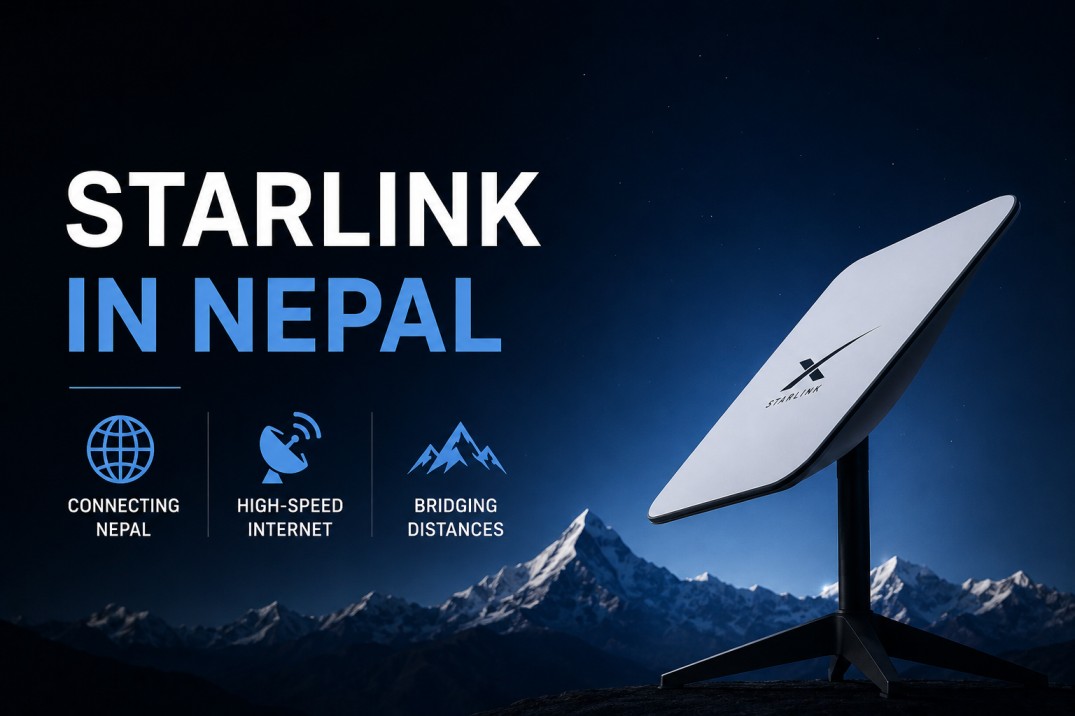
For years, Elon Musk’s Starlink has been trying to enter Nepal. In 2026, discussions intensified again after Starlink representatives met Nepali government officials to explore the possibility of launching satellite internet services in the country. However, regulatory hurdles, ownership requirements, and concerns from existing internet providers continue to delay its arrival.
If Starlink eventually launches in Nepal, it could become one of the most transformative developments in the country’s digital history. At the same time, it could create significant challenges for local telecom companies, regulators, and even Starlink itself.
What Is Starlink?
SpaceX operates Starlink, a satellite-based broadband internet service that uses thousands of Low Earth Orbit (LEO) satellites to provide internet access almost anywhere on Earth.
Unlike traditional internet providers that rely on:
- Fiber-optic cables
- Mobile towers
- Microwave links
Starlink connects users directly through satellite terminals installed at homes, businesses, schools, and remote locations.
Why Nepal Is an Attractive Market for Starlink
Nepal is one of the most geographically challenging countries in the world.
The country’s terrain includes:
- Himalayan mountain ranges
- Remote villages
- Deep valleys
- Areas where fiber deployment is expensive
While internet penetration has grown significantly, many rural regions still struggle with slow speeds and unreliable connectivity. Even with millions of broadband users, network quality remains inconsistent in many areas.
For Starlink, Nepal presents a market where satellite internet can solve problems that traditional infrastructure cannot easily address.
Opportunities for Nepal
Connecting Remote Villages
The biggest advantage would be internet access in areas where fiber networks are economically difficult to deploy.
Potential beneficiaries include:
- Mountain communities
- Rural municipalities
- Schools
- Health posts
- Remote government offices
Starlink has previously discussed providing connectivity to remote public institutions in Nepal.
Better Internet for Tourism
Tourism is one of Nepal’s largest industries.
Locations such as:
- Mount Everest region
- Annapurna Circuit
- Trekking routes
- High-altitude lodges
often face connectivity challenges.
Reliable satellite internet could:
- Improve tourist experiences
- Support digital payments
- Enable remote work
- Increase safety and communication
Growth of Remote Work and Digital Economy
A growing number of Nepalis work online for international clients.
Reliable internet in smaller towns could:
- Create employment opportunities
- Support freelancers
- Encourage tech startups
- Reduce migration to Kathmandu
Community discussions frequently highlight digital nomad and remote work opportunities as a major potential benefit.
Disaster Resilience
Nepal is highly vulnerable to:
- Earthquakes
- Landslides
- Floods
Traditional communication infrastructure can be damaged during disasters.
Satellite internet could provide emergency connectivity when:
- Towers fail
- Fiber links are cut
- Roads become inaccessible
This may strengthen disaster response capabilities nationwide.
Opportunities for Starlink
Nepal also offers significant advantages for Starlink.
Untapped Rural Market
Large portions of Nepal still lack high-quality broadband access.
Starlink could:
- Serve remote households
- Connect tourism businesses
- Provide enterprise services
- Partner with government projects
Strategic Himalayan Presence
Nepal’s geography makes it an ideal showcase market for satellite connectivity.
If Starlink performs well in Nepal’s mountains, it strengthens its reputation globally as a solution for difficult terrain.
Challenges Facing Starlink in Nepal
Ownership Rules
Perhaps the biggest obstacle is regulation.
Nepal’s telecommunications framework requires foreign telecom operators to comply with local ownership and licensing requirements. Reports indicate Starlink prefers significant operational control, which conflicts with existing regulations.
Until a compromise is reached, obtaining approval remains difficult.
Licensing and Legal Compliance
Nepal Telecommunications Authority (NTA) has repeatedly stated that telecom services require proper authorization.
The regulator has even warned against unauthorized Starlink usage in certain regions.
Starlink would need:
- Regulatory approval
- Licensing
- Compliance with telecom laws
- Security clearances
before commercial operations can begin.
Pricing Challenges
One major question is affordability.
Globally, Starlink generally requires:
- Hardware purchase
- Monthly subscription fees
For many Nepali households, these costs could be significantly higher than traditional broadband packages.
As a result, Starlink may initially appeal more to:
- Businesses
- Hotels
- Remote lodges
- NGOs
- Government agencies
rather than average urban consumers.
Community discussions frequently mention pricing as a concern.
Challenges for Nepal
National Security Concerns
Telecommunications infrastructure is considered a strategic national asset.
Regulators may examine:
- Data governance
- Lawful interception requirements
- Emergency controls
- National security implications
These concerns are common globally when foreign satellite operators enter new markets.
Regulatory Adaptation
Nepal’s telecom laws were largely designed around:
- Mobile operators
- Traditional ISPs
- Fiber networks
Satellite internet introduces new challenges requiring updated regulatory frameworks.
Impact on Existing Internet Providers
One of the biggest debates revolves around how Starlink would affect Nepal’s internet industry.
Major providers include:
- WorldLink
- Nepal Telecom
- Ncell
- DishHome
- Subisu
Increased Competition
The most immediate effect would be increased competition.
Potential outcomes:
- Better customer service
- Faster network upgrades
- More competitive pricing
- Improved reliability
Many internet users view competition as a positive force for service improvement.
Pressure on Rural Business Models
Some providers rely heavily on serving remote and semi-rural regions.
If Starlink becomes competitive in these areas:
- Customer losses could occur
- Revenue may decline
- Expansion plans could change
Industry concerns about business disruption and possible job impacts have already been reported.
Acceleration of Fiber and 5G Investments
Rather than causing collapse, Starlink may push local companies to innovate faster.
Nepal’s telecom sector is already investing in:
- Additional towers
- Network upgrades
- Future 5G deployments
Competition from satellite internet could accelerate these investments.
Will Starlink Replace Fiber Internet?
Probably not.
Fiber still has advantages:
- Lower latency
- Higher capacity
- Lower long-term cost per user
- Better performance in dense cities
Starlink is strongest where fiber is weakest:
- Mountains
- Remote settlements
- Temporary sites
- Disaster zones
In major cities such as Kathmandu, Pokhara, and Biratnagar, fiber broadband will likely remain the primary internet technology for most households.
The India Factor
Starlink’s recent progress in India demonstrates that South Asia is becoming increasingly important for satellite internet expansion. However, even after obtaining key approvals, regulatory and operational steps remain necessary before full deployment.
Nepal will be watching these developments closely as it evaluates its own framework.
Final Thoughts
Starlink’s arrival in Nepal could be a game-changing moment for connectivity, particularly in remote and mountainous regions where traditional internet infrastructure remains difficult and expensive to build. The service could improve education, tourism, healthcare, disaster response, and digital employment opportunities across the country.
However, significant questions remain regarding regulation, ownership, affordability, national security, and the impact on local internet providers. Starlink’s biggest challenge may not be technology—it may be finding a model that satisfies Nepal’s laws while remaining commercially viable.
If a compromise is reached, the most likely outcome is not the replacement of Nepal’s existing ISPs, but a more competitive internet ecosystem where fiber, mobile broadband, and satellite internet coexist, each serving different parts of the country.