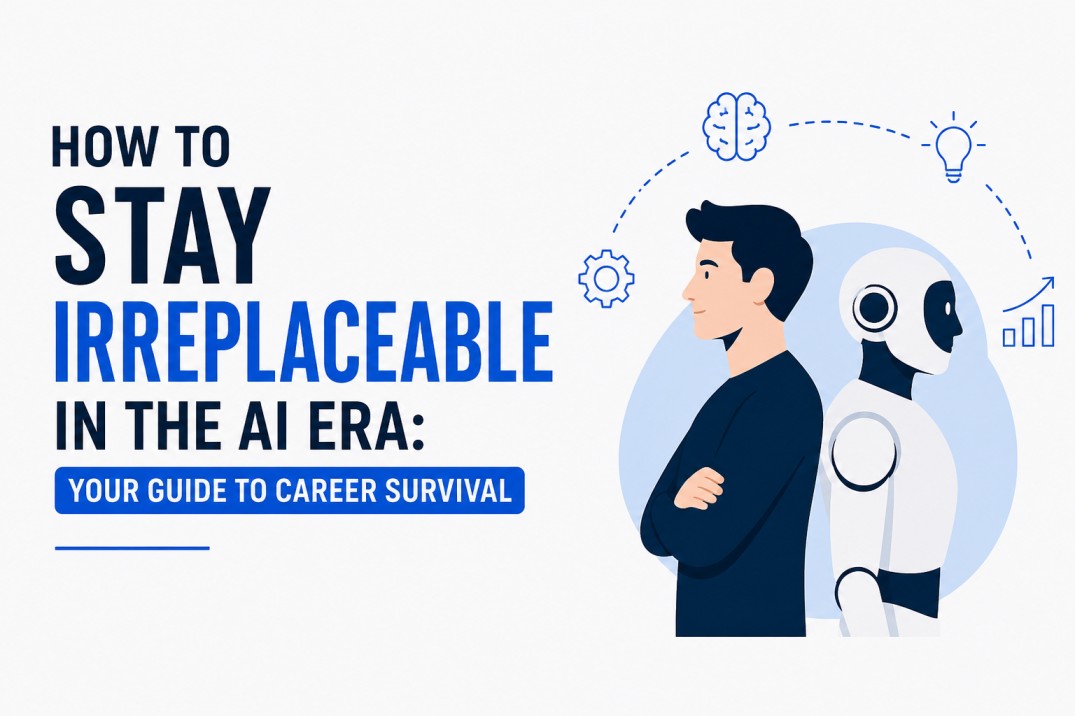
Artificial intelligence is no longer a futuristic concept—it is reshaping industries at an unprecedented pace. From software development and marketing to finance, customer service, and content creation, AI tools are changing how professionals work and how companies hire. Rather than simply replacing repetitive tasks, AI is enabling smaller teams to accomplish work that once required entire departments.
This transformation has sparked an important question for millions of professionals worldwide: How can you remain valuable in an AI-driven workplace?
The answer isn’t to compete against AI—it’s to learn how to work alongside it. Those who embrace AI as a productivity tool are likely to thrive, while those who ignore it risk falling behind as businesses increasingly adopt automation and intelligent software.
Here’s a practical guide to staying relevant and building a future-proof career in the age of artificial intelligence.
Why AI Is Reshaping White-Collar Jobs
For decades, automation mainly affected manufacturing and repetitive physical labor. Today, generative AI and intelligent automation are transforming many knowledge-based professions.
Tasks that once consumed hours—writing reports, analyzing data, coding, creating presentations, summarizing meetings, or responding to emails—can now often be completed in minutes with the help of AI.
Rather than eliminating every job, AI is changing the skills employers value. Professionals who know how to combine their expertise with AI tools can often produce higher-quality work more efficiently than before.
The First Step: Change Your Mindset
The biggest difference between professionals who succeed in the AI era and those who struggle is often their mindset.
The Fear-Driven Approach
Some people view AI only as a threat. They avoid learning new tools, hoping the technology will not affect their careers.
Unfortunately, technology rarely waits.
The Growth-Oriented Approach
Others see AI as an opportunity to increase their productivity.
Instead of asking:
“Will AI replace me?”
They ask:
“How can AI help me become significantly better at my job?”
This mindset encourages continuous learning and adaptation—two qualities that have always been valuable in fast-changing industries.
Essential AI Skills Every Professional Should Learn
1. Learn Effective Prompting
AI models produce better results when given clear instructions.
Rather than asking vague questions, learn to provide:
- Clear objectives
- Relevant background information
- Examples
- Desired output format
- Constraints and limitations
Good prompting helps AI generate more accurate, useful, and consistent responses.
2. Learn Multiple AI Tools
Different AI tools have different strengths.
For example:
- ChatGPT for brainstorming, coding, writing, and analysis
- Google Gemini for Google Workspace integration
- Claude for long-form reasoning and document analysis
- Perplexity for AI-assisted research with cited sources
- GitHub Copilot for software development
Knowing when to use each tool can significantly improve productivity.
3. Build AI Workflows
The real productivity gains come from combining multiple AI tools into repeatable workflows.
Examples include:
- Research → AI summarization → Report generation
- Meeting recording → Transcription → Summary → Task list
- Content planning → Writing → Editing → Social media publishing
Automating repetitive processes allows professionals to focus on higher-value work.
4. Combine AI With Industry Expertise
Generic AI knowledge alone is unlikely to create long-term value.
Professionals become more valuable when they combine AI with deep expertise in areas such as:
- Healthcare
- Finance
- Law
- Marketing
- Engineering
- Education
- Cybersecurity
- Project management
Domain expertise helps users verify AI outputs, apply industry context, and make informed decisions.
5. Stay Updated
Artificial intelligence evolves rapidly.
New models, features, and productivity tools appear almost every month.
Building a habit of following:
- AI company announcements
- Developer blogs
- Industry newsletters
- Technical communities
- Research publications
can help professionals discover useful tools before they become mainstream.
Human Skills That AI Cannot Easily Replace
While AI excels at processing information, several human capabilities remain difficult to automate.
Critical Thinking
AI can generate suggestions, but humans must evaluate whether those suggestions are accurate, ethical, and appropriate.
Strong decision-making remains an essential workplace skill.
Creativity
Although AI can generate ideas, breakthrough innovation often comes from combining experiences, emotions, and unique perspectives.
Human creativity continues to play an important role in design, storytelling, entrepreneurship, and product development.
Communication
Building relationships, negotiating agreements, leading teams, and managing clients require empathy, trust, and emotional intelligence.
These interpersonal skills remain highly valuable.
Adaptability
Technology changes quickly.
Professionals willing to learn continuously are generally better positioned to adapt to new tools and workplace expectations.
Leadership
AI can assist managers with planning and analysis, but motivating teams, resolving conflicts, and setting strategic direction remain fundamentally human responsibilities.
Careers Most Likely to Benefit From AI
Rather than replacing every profession, AI is expected to become a productivity partner in many fields, including:
- Software development
- Digital marketing
- Graphic design
- Finance
- Accounting
- Data analysis
- Healthcare administration
- Education
- Human resources
- Customer support
Professionals who integrate AI into their daily workflows may gain a competitive advantage.
Practical Ways to Prepare Today
You don’t need to become an AI researcher to benefit from artificial intelligence.
Instead, consider practical steps such as:
- Experiment with AI tools regularly
- Automate repetitive tasks
- Improve digital literacy
- Build problem-solving skills
- Learn prompt writing
- Strengthen communication and collaboration
- Develop expertise in your chosen field
- Create a portfolio showcasing AI-assisted projects
Small, consistent improvements often have a greater long-term impact than trying to master every new technology immediately.
Common Mistakes to Avoid
As AI adoption grows, avoid these common pitfalls:
- Blindly trusting AI-generated information without verification
- Ignoring privacy and data security considerations
- Depending entirely on AI without understanding the underlying work
- Failing to update skills as technology evolves
AI should enhance professional judgment—not replace it.
What Employers Are Looking For
Many organizations are increasingly seeking professionals who can:
- Use AI responsibly
- Learn new technologies quickly
- Improve productivity
- Think critically
- Communicate effectively
- Solve complex business problems
- Collaborate across teams
Technical knowledge combined with strong human skills creates a powerful combination.
The Future of Work
Artificial intelligence is likely to become a standard workplace tool, much like email, spreadsheets, and cloud computing.
Instead of replacing every professional, AI is expected to reshape job responsibilities and increase expectations around productivity and adaptability.
Those who embrace lifelong learning and learn how to collaborate effectively with AI will be better positioned for future opportunities.
Final Thoughts
The AI era is not simply about automation—it is about transformation. While technology will continue to change how work is performed, qualities such as creativity, critical thinking, emotional intelligence, leadership, and adaptability remain difficult to automate.
Rather than fearing AI, professionals should focus on learning how to use it responsibly and effectively. By combining technical knowledge with uniquely human strengths, individuals can build resilient careers and remain valuable in an increasingly AI-powered world.
The future is unlikely to belong solely to artificial intelligence or to humans working alone. It will belong to people who know how to work with AI to solve real-world problems, deliver meaningful results, and continue learning as technology evolves.
9 Web Tools you must try: https://techsathi.com/9-secret-web-tools-and-extensions-you-didnt-know-you-needed/