
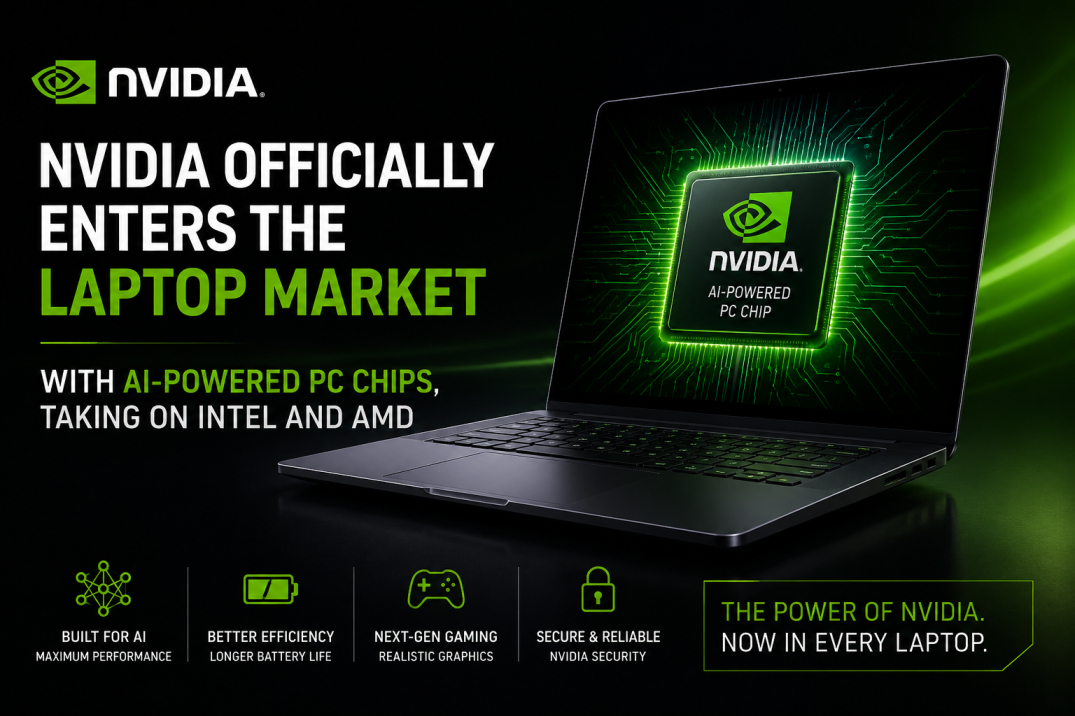
NVIDIA Officially Enters the Laptop Market, marking one of the biggest shifts in the PC industry in years. During its major Computex 2026 announcements, the company unveiled its new RTX Spark platform — an AI-focused superchip designed for next-generation Windows laptops and desktop PCs. The move puts NVIDIA into direct competition with longtime processor giants including Intel, AMD, and even Qualcomm in the growing AI PC market.
The announcement represents NVIDIA’s biggest expansion beyond graphics cards and AI servers, signaling its ambition to redefine how personal computers work in the age of artificial intelligence.
NVIDIA Wants to Reinvent the Personal Computer
According to NVIDIA CEO Jensen Huang, traditional PCs are entering a completely new era.
For decades, computers have operated primarily through:
- Mouse clicks
- Keyboard inputs
- Traditional software applications
NVIDIA now believes AI agents will become the next major interface for computing. Instead of opening apps and manually performing tasks, users will increasingly interact with AI assistants capable of handling complex workflows automatically.
The company describes this transition as moving from computers being simple tools to becoming intelligent digital teammates.
Introducing RTX Spark: NVIDIA’s New AI Superchip
At the center of NVIDIA’s strategy is the new RTX Spark superchip.
The company calls it:
“The most efficient PC chip ever built.”
The chip combines:
- NVIDIA Grace CPU architecture
- NVIDIA Blackwell RTX graphics
- Advanced Tensor AI cores
- Unified memory architecture
- AI acceleration engines
Unlike traditional laptops that separate CPUs and GPUs, RTX Spark tightly integrates all major computing components into a single AI-focused platform.
Massive AI Performance
One of the most surprising aspects of RTX Spark is its AI capability.
Reports suggest the flagship configuration includes:
- Up to 20 CPU cores
- 6,144 CUDA GPU cores
- Fifth-generation Tensor Cores
- Up to 128GB unified memory
- Up to 1 petaflop of AI performance
This level of processing power allows laptops to run extremely large AI models directly on-device without relying entirely on cloud services.
NVIDIA says users will be able to:
- Run advanced AI assistants locally
- Generate AI images and videos
- Process massive datasets
- Use AI coding tools
- Handle professional creative workloads
all from a portable Windows laptop.
Built for the New Era of AI Agents
A major focus of NVIDIA’s presentation was the concept of “personal AI agents.”
These agents are designed to:
- Understand natural language
- Perform tasks automatically
- Work across applications
- Handle long workflows independently
- Assist with productivity and creativity
NVIDIA says future PCs will allow users to simply describe what they want done rather than manually operating multiple applications.
The company is partnering closely with Microsoft to integrate these AI agent capabilities directly into Windows.
Taking Direct Aim at Intel and AMD
For years, Intel and AMD have dominated laptop processors.
Now NVIDIA is challenging that dominance by combining:
- AI acceleration
- Gaming performance
- Power efficiency
- Advanced graphics technology
Unlike Intel and AMD’s traditional x86 processors, RTX Spark uses Arm-based architecture developed with assistance from MediaTek.
This approach is similar to:
- Apple Silicon Macs
- Qualcomm Snapdragon X laptops
NVIDIA believes Arm-based AI PCs can deliver:
- Better battery life
- Higher efficiency
- More AI performance
- Thinner laptop designs
than traditional processor architectures.
Gaming Still Remains a Huge Focus
Despite the AI emphasis, NVIDIA is not abandoning gaming.
The company says RTX Spark supports:
- RTX ray tracing
- DLSS upscaling
- Reflex latency reduction
- High-refresh-rate gaming
- AAA titles at 1440p
Reports suggest some configurations may deliver graphics performance close to RTX 5070-class hardware while maintaining laptop-level efficiency.
This could make RTX Spark-powered laptops appealing to:
- Gamers
- Content creators
- Developers
- AI researchers
all within a single machine.
Adobe and Major Software Companies Are Already On Board
NVIDIA confirmed partnerships with major software developers.
According to the company:
- Adobe Photoshop is being optimized for RTX Spark
- Adobe Premiere is receiving AI acceleration upgrades
- Blender support is expanding
- Creative AI workflows are being redesigned around the platform
NVIDIA claims some AI-powered creative tasks may run up to twice as fast compared to current systems.
Laptop Brands Are Already Preparing Devices
Several major laptop manufacturers have already announced support for RTX Spark.
Expected partners include:
- ASUS
- Dell
- HP
- Lenovo
- Microsoft Surface
- MSI
- Acer
- GIGABYTE
Reports suggest more than 30 laptop models and multiple desktop systems are already under development.
The Windows-on-Arm Market Just Got More Competitive
Before NVIDIA’s entry, Windows-on-Arm laptops were largely dominated by Qualcomm.
Now the market includes:
- Qualcomm Snapdragon X
- Apple Silicon (macOS)
- NVIDIA RTX Spark
- Traditional Intel chips
- Traditional AMD chips
This creates one of the most competitive PC processor battles in years.
Industry analysts believe the AI PC market could become the next major battleground in consumer technology.
Potential Challenges NVIDIA Could Face
Despite the excitement, NVIDIA still faces several challenges.
Key concerns include:
- Compatibility with older x86 applications
- Software optimization
- Pricing
- Battery life under heavy AI workloads
- Competition from Apple Silicon
- Strong existing Intel and AMD ecosystems
Microsoft’s Prism emulation system is expected to help improve compatibility with older Windows applications running on Arm-based systems.
Availability
NVIDIA says RTX Spark-powered laptops and compact desktop PCs will begin launching in Fall 2026.
The first wave of devices will come from major PC manufacturers, with broader expansion expected throughout 2027.
Final Thoughts
NVIDIA’s entrance into the laptop processor market is one of the most significant PC industry developments in years. With RTX Spark, the company is no longer focusing only on graphics cards and AI servers — it is attempting to redefine the future of personal computing itself.
By combining AI acceleration, gaming performance, unified memory, and Arm-based efficiency into a single platform, NVIDIA is positioning itself as a serious challenger to Intel, AMD, Qualcomm, and even Apple in the race to build the next generation of AI-powered computers. Whether RTX Spark becomes a true industry disruptor will depend on real-world performance, software support, and pricing, but its arrival has already changed the conversation around the future of Windows laptops.