
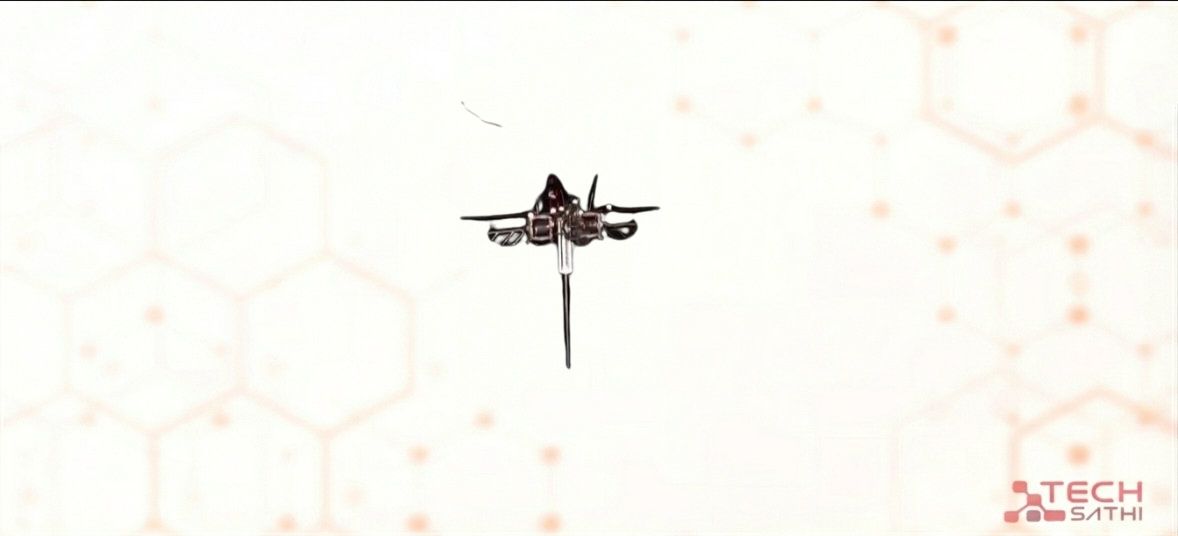
MIT researchers have developed an AI-powered control system that makes an insect-scale flying robot dramatically faster and agile enough to perform 10 somersaults in just 11 seconds.
AI Makes a Tiny Robot 450% Faster
What happens when you give a tiny flying robot an AI-powered “brain”?
It starts moving more like an insect.
Researchers at the Massachusetts Institute of Technology (MIT) have developed a new AI-based control system that helped an insect-scale flying robot increase its speed by about 447% and its acceleration by 255% compared with the team’s previous demonstrations.
The tiny robot can also perform 10 consecutive somersaults in just 11 seconds, while staying within around 4–5 centimeters of its planned flight path.
That could eventually turn these miniature robots into useful tools for exploring spaces that are too tight or dangerous for conventional drones.
A Robot Smaller Than a Paperclip
The robot is roughly the size of a microcassette and weighs less than a paperclip.
Instead of using conventional propellers, it flies with flapping wings powered by soft artificial muscles. The wings beat rapidly to generate the forces needed for flight.
Despite the robot’s small size, controlling it is extremely difficult.
Tiny changes in wind, position or movement can have a major effect on such a lightweight machine. Previously, the robot’s flight controller had to be tuned manually, which limited how aggressively it could move.
That is where AI comes in.
AI Becomes the Robot’s Flight Brain
MIT researchers created a two-stage AI-driven control system to give the robot faster and more reliable decision-making.
The first stage uses a model-predictive controller. It calculates how the robot should move and plans complex maneuvers such as sharp turns, body tilts and somersaults.
The researchers then used deep learning and imitation learning to train a faster AI model using the behavior of that more computationally intensive controller.
In simple terms, the system first figures out the difficult flight maneuvers and then teaches a faster AI model how to reproduce them in real time.
The result is a robot that can react much faster than the previous manually tuned system.
10 Somersaults in 11 Seconds
The most eye-catching demonstration is the robot’s ability to perform 10 consecutive somersaults in 11 seconds.
Keeping the robot stable during one flip is already difficult. Repeating the maneuver requires the robot to finish one rotation in exactly the right position and speed to begin the next one.
Even small errors can accumulate and cause the robot to crash.
The AI controller helped the robot maintain its trajectory despite disturbances, including wind. MIT reported that the robot stayed within roughly 4 or 5 centimeters of its planned path during the demonstrations.
It Can Move Like an Insect
The researchers also demonstrated a movement called a saccade.
In insects, this involves rapidly changing body orientation, accelerating toward a new position and then pitching in the opposite direction to slow down.
This type of movement helps insects reposition themselves quickly.
MIT researchers believe similar movements could eventually help robotic insects navigate their surroundings once cameras and sensors are added to the machines.
The goal isn’t simply to make a tiny robot perform impressive flips.
Researchers want these machines to eventually move through environments where larger drones struggle.
Could Tiny Robots Search Through Earthquake Rubble?
One potential application is search and rescue.
A conventional drone may have difficulty flying through narrow gaps in collapsed buildings. A robot that is small enough to move like an insect could potentially navigate between pieces of rubble and reach areas that larger machines cannot.
MIT researchers specifically point to future scenarios where these robots could help search for survivors trapped beneath earthquake rubble.
The tiny size could become a major advantage rather than a limitation.
Instead of sending a large drone into a dangerous or confined environment, rescuers could potentially deploy several miniature robots to explore different areas.
The Robots Are Not Fully Autonomous Yet
There is an important limitation.
The current AI controller runs on an external computer rather than directly onboard the tiny robot. MIT researchers say adding onboard cameras and sensors so the robot can operate outdoors without a complex external motion-capture system is an important area of future work.
Researchers also want to explore whether onboard sensing could allow multiple robots to avoid collisions and coordinate their movements.
So, while the demonstration looks futuristic, the technology is still at the research stage.
Why This AI Breakthrough Matters
The most interesting part of the research isn’t simply that a tiny robot can perform backflips.
It shows how AI can improve the control of physical machines.
The robot already had wings, artificial muscles and a compact mechanical design. The major improvement came from teaching an AI system how to control that hardware more effectively.
That could become increasingly important as robots get smaller.
For large robots, there is more room for batteries, sensors and computing hardware. Tiny robots have much tighter limitations. Better AI control could help researchers get more performance from relatively small machines.
MIT says the research demonstrates that soft and microrobots can use advanced control algorithms to achieve agility approaching that of natural insects.
The Future Could Be Filled With Tiny AI Robots
Today’s demonstration is a research milestone, but the potential applications go beyond search and rescue.
Future versions could potentially carry cameras and sensors, work together in groups, inspect difficult-to-reach spaces or explore environments where traditional drones are too large.
The combination of miniaturized hardware and AI-powered control could create a completely different category of robots.
And perhaps the most surprising part is this: the future of robotics may not only belong to giant humanoid machines.
It could also belong to robots small enough to fit through a crack in a wall.
Also read: