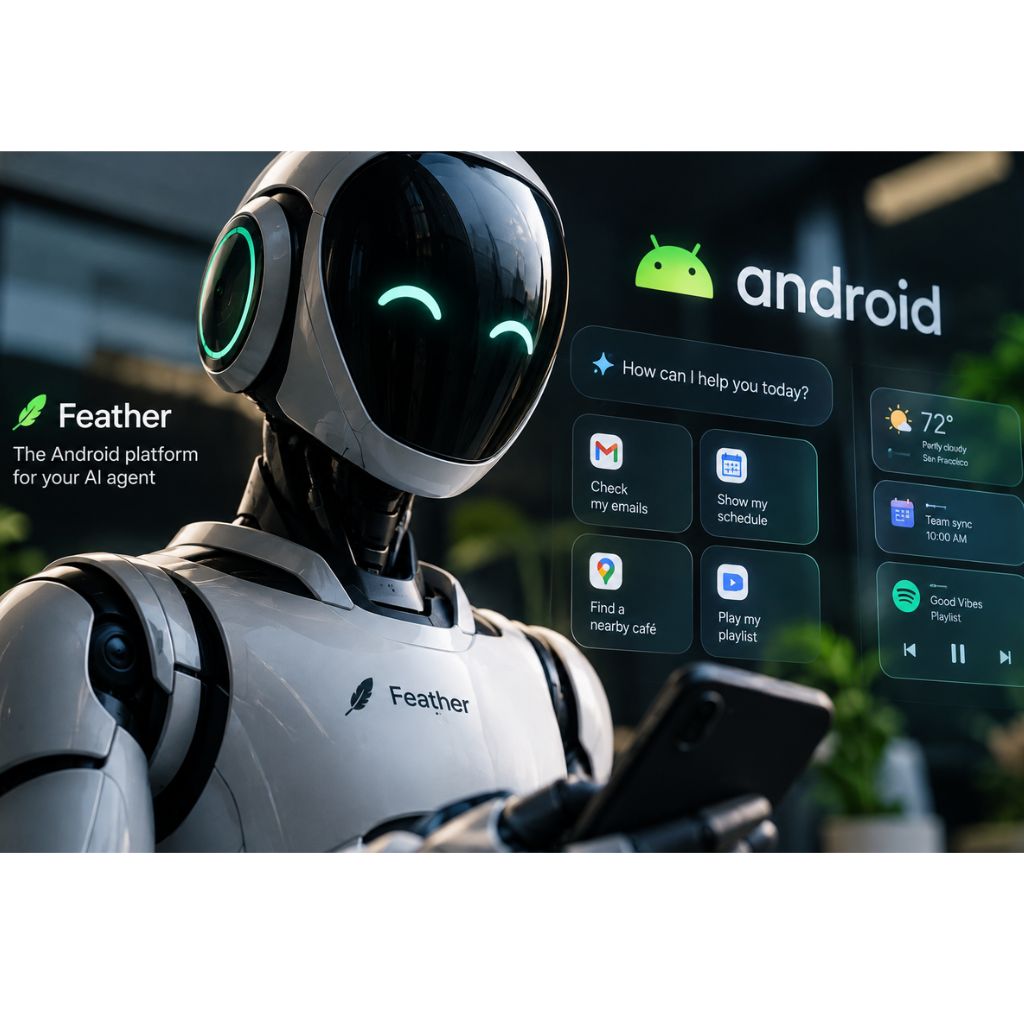
Feather Robotics is building a modular humanoid robot platform that aims to give developers an easier way to build real-world applications for robots.
What If Robots Had Their Own Android?
Imagine buying a robot without having to build its entire software system from scratch.
That is the idea behind Feather Robotics, a startup developing a modular humanoid platform for developers. The company wants to become what it describes as the “Android of robotics” by giving developers hardware and software tools they can build on.
The approach is different from companies trying to build a complete humanoid robot and its general-purpose AI system at the same time.
Instead, Feather is focusing on making a robot platform that other developers can customize and program for specific tasks.
Feather Wants to Make Robot Development Easier
Building a useful humanoid robot involves much more than creating a mechanical body.
Developers also need to deal with movement, sensors, computing, control systems and AI models. Feather’s pitch is to provide much of that underlying hardware and software so developers can focus more on the application itself.
The company says its platform includes modular hardware, an open SDK, Python and ROS2 support, simulation support, teleoperation, inverse kinematics and collision detection.
That could allow developers to move from a trained AI model to a physical robot without designing an entire robotic system from the ground up.
Why the “Android of Robotics” Idea Matters
Android changed smartphones by giving manufacturers and developers a common software platform to build around.
Feather is trying to apply a similar idea to robotics.
Instead of every robotics company developing its own complete hardware stack, Feather wants developers to use its platform as a starting point and create different applications on top of it.
However, the “Android of robotics” description is Feather’s vision rather than an established industry standard. The company still has to prove that a broader developer ecosystem can form around its platform.
The Robot Is Designed to Be Modular
Feather’s system is not intended to be a fixed robot configuration.
The company says developers can customize parts of the platform for different applications, including changing arm configurations. It also lists a modular end effector and swappable onboard computing among the system’s features.
The robot has a reported 1-meter reach, a holonomic base capable of moving in any direction, and dual hot-swappable batteries with a stated battery life of up to 10 hours.
This modular approach could be important because a robot working in a restaurant may need different hardware from one working in a laboratory or manufacturing environment.
A $30,000 Robot You Can Build On
One of Feather’s most interesting claims is its price.
The company’s website currently lists the robot at $29,990, while TechCrunch reported a roughly $30,000 price and said the company had already surpassed $1 million in revenue.
For comparison, TechCrunch reported that Feather’s robot costs about half as much as Unitree’s H2 Edu.
The company is positioning the price as a way for businesses and developers to experiment with physical AI without building an entire robot themselves.
These Robots Are Already Doing Real Work
This isn’t only a laboratory concept.
According to TechCrunch, Feather said its robots are already being used as cooks in restaurants and for cleaning science laboratories. The company has not publicly identified its customers.
Feather also says its platform has been working in fields including manufacturing and food service.
The company says its robots can run models from robotics AI providers including NVIDIA, Skild and Physical Intelligence, giving developers flexibility over the AI systems they use.
Feather Has Raised $7.6 Million
Feather Robotics was founded in 2025 by Hoa Mai and Parsa Bakhtiari.
The company recently announced a $7.6 million pre-seed funding round led by Gradient Ventures, with participation from Builder Capital, Geometry, SEED Innovations and Virgo VC.
Feather says it has already moved through prototype development, early orders and field testing and is preparing for a larger product launch.
Could This Change the Future of Robots?
The bigger idea isn’t simply about one humanoid robot.
If platforms like Feather become widely adopted, developers could focus on creating robot applications rather than spending years building the underlying hardware and control systems.
That could eventually lead to a world where robots become more like computers or smartphones: the hardware provides the foundation, while developers create different software and applications for specific jobs.
But that future is not guaranteed.
Feather still needs to grow its developer ecosystem and demonstrate that its platform can scale across different real-world applications. For now, its approach represents an interesting shift in robotics—from trying to build one robot that can do everything toward building a platform that lets many developers teach robots different jobs.
And that is what makes the idea interesting: the next big robotics breakthrough may not be a smarter robot, but a platform that lets thousands of people build smarter robots.
Also read: