
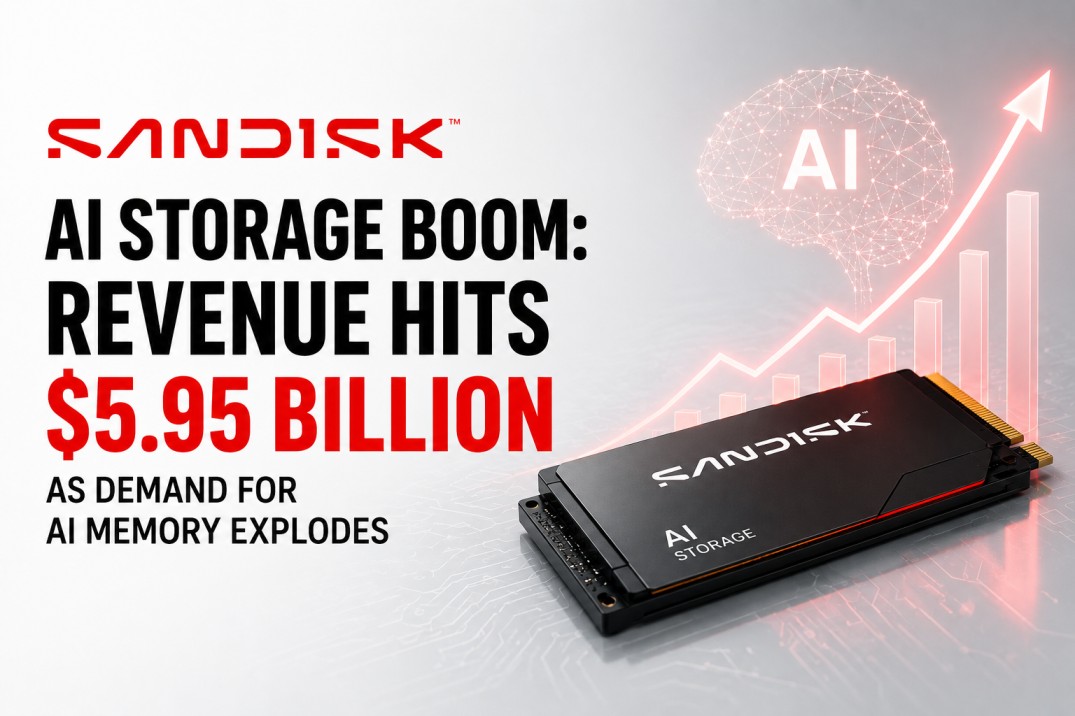
AI infrastructure demand is now reshaping the global storage industry — and Sandisk is emerging as one of the biggest winners of the AI boom.
The memory and storage giant reported a massive surge in fiscal Q3 2026 revenue, reaching $5.95 billion, fueled by explosive demand for AI-driven storage systems, enterprise SSDs, and hyperscale data center infrastructure. At the same time, the company revealed it has secured at least $42 billion in long-term supply agreements, signaling how critical storage has become in the artificial intelligence era.
AI Is Driving a New Storage Supercycle
For years, GPUs dominated discussions around AI infrastructure. But the rise of large language models, AI agents, and multimodal systems is now pushing storage demand to historic levels.
AI systems increasingly require:
- Massive datasets
- High-speed memory access
- Persistent storage for training and inference
- Enterprise-scale SSD infrastructure
This has transformed NAND flash memory and enterprise storage into a critical layer of AI infrastructure.
Sandisk’s latest earnings show how quickly this market is expanding.
Sandisk Revenue Surges to $5.95 Billion
Sandisk reported fiscal Q3 2026 revenue of $5.95 billion, dramatically surpassing analyst expectations and marking a major turnaround from the previous year.
Key highlights include:
- Revenue up more than 250% year-over-year
- Strong growth in enterprise SSD and data center storage
- Datacenter revenue surged significantly due to AI infrastructure demand
- Higher average selling prices for NAND storage products
The company also posted exceptionally strong profitability as pricing power improved across the memory market.
$42 Billion in Long-Term AI Supply Contracts
One of the biggest announcements from the quarter was Sandisk’s move toward long-term customer agreements.
The company disclosed:
- Five major long-term supply agreements
- Contracts lasting between one and five years
- At least $42 billion in minimum contractual revenue from several agreements
- More than $11 billion in financial guarantees tied to the deals
This represents a major shift for the memory industry, which has historically been highly cyclical and volatile.
CEO David Goeckeler said the company is moving toward a more predictable business model built around long-term AI infrastructure demand.
Why AI Needs So Much Storage
Modern AI systems generate and process enormous amounts of data.
Applications driving storage demand include:
- Large language models
- AI coding systems
- Video generation models
- Enterprise AI assistants
- Autonomous AI agents
- Scientific and medical AI workloads
Unlike traditional computing, AI systems require both:
- Fast compute (GPUs)
- Massive storage capacity and memory bandwidth
This is creating unprecedented demand for:
- NAND flash memory
- Enterprise SSDs
- High-performance storage arrays
- AI data center infrastructure
The AI Infrastructure Race Is Expanding Beyond GPUs
The AI boom initially centered around companies like Nvidia. However, the latest trend shows the infrastructure race is expanding deeper into the technology stack.
Now, demand is rising across:
- Storage systems
- Networking hardware
- Power infrastructure
- Cooling systems
- AI memory chips
This shift is benefiting companies like Micron Technology, Western Digital, and Seagate Technology.
Sandisk’s New Business Model Could Change the Industry
Analysts say Sandisk’s long-term supply contract strategy could fundamentally reshape the NAND memory market.
Traditionally, memory companies faced:
- Sharp price crashes
- Inventory oversupply
- Extreme boom-bust cycles
Now, AI infrastructure customers are signing multi-year agreements to secure future supply due to fears of prolonged shortages.
This gives Sandisk:
- Better revenue visibility
- More stable margins
- Predictable production planning
- Reduced exposure to price volatility
AI Storage Demand Could Stay Strong for Years
Industry analysts believe AI-driven storage demand is still in its early stages.
Key drivers include:
- Rapid growth of AI-generated content
- Expansion of hyperscale AI data centers
- Growth in enterprise AI adoption
- Increasing model sizes and context windows
- Rising need for real-time AI inference
Some forecasts suggest storage shortages could continue through the late 2020s as AI infrastructure scales globally.
Conclusion
Sandisk’s Q3 2026 results show that the AI revolution is no longer just a GPU story.
Storage has become one of the most important layers of the AI infrastructure stack, and companies capable of supplying high-performance NAND memory are now seeing explosive demand.
With $5.95 billion in quarterly revenue and $42 billion in long-term contracts, Sandisk is positioning itself as a major infrastructure player in the next phase of the AI economy.
FAQ
AI systems process massive datasets and require high-speed storage for training, inference, and real-time data access.
Sandisk reported approximately $5.95 billion in revenue for fiscal Q3 2026.
The company disclosed at least $42 billion in long-term supply agreements tied to AI infrastructure demand.
Enterprise SSDs, NAND flash memory, and AI data center storage products are driving growth.
They provide supply certainty, reduce price volatility, and help manufacturers plan future production capacity.
Cloud computing, hyperscale data centers, enterprise AI, autonomous systems, and generative AI are major demand drivers.


This is my first time pay a quick visit at here and i am really happy to read everthing at one place
I’m often to blogging and i really appreciate your content. The article has actually peaks my interest. I’m going to bookmark your web site and maintain checking for brand spanking new information.
I am truly thankful to the owner of this web site who has shared this fantastic piece of writing at at this place.
I am truly thankful to the owner of this web site who has shared this fantastic piece of writing at at this place.
Pretty! This has been a really wonderful post. Many thanks for providing these details.
Good post! We will be linking to this particularly great post on our site. Keep up the great writing
I’m often to blogging and i really appreciate your content. The article has actually peaks my interest. I’m going to bookmark your web site and maintain checking for brand spanking new information.