
Skip to content
May 7, 2026
  • Apple Q2 2026 Earnings: $111.2B Revenue, iPhone Surge and Services Hit Record High
  • Meta’s Custom AI Chips Strategy: Reducing Dependence on Nvidia in the AI Infrastructure Race
  • PlayStation 6 Leaks: Everything We Know So Far About Sony’s Next-Gen Console
  • GoPro Mission 1 Pro Ultimate Creator Review: The Complete Filmmaking Kit in One Package?
Newsletter
Random News
TechSathi

TechSathi

Nepal’s go-to platform for tech-news. We want to be your Tech Sathi !

  • NewsLatest news about gadget launches, app launches, company launches and many more, you shouldn’t be missing out.
  • Gadgets
  • Reviews
  • Buy GuidesBest of everything, from apps, smartphones, cameras, accessories, laptops and peripherals.
  • EV
  • Startups
  • EventsA storehouse of information about national and international events happening in your periphery. Find out how to participate, and how to access.
  • Tech Stories
  • Fintech
  • Home
  • News
  • Meta’s Custom AI Chips Strategy: Reducing Dependence on Nvidia in the AI Infrastructure Race
  • News

Meta’s Custom AI Chips Strategy: Reducing Dependence on Nvidia in the AI Infrastructure Race

Dawa3 days ago3 days ago08 mins
Meta AI chips Nvidia dependence

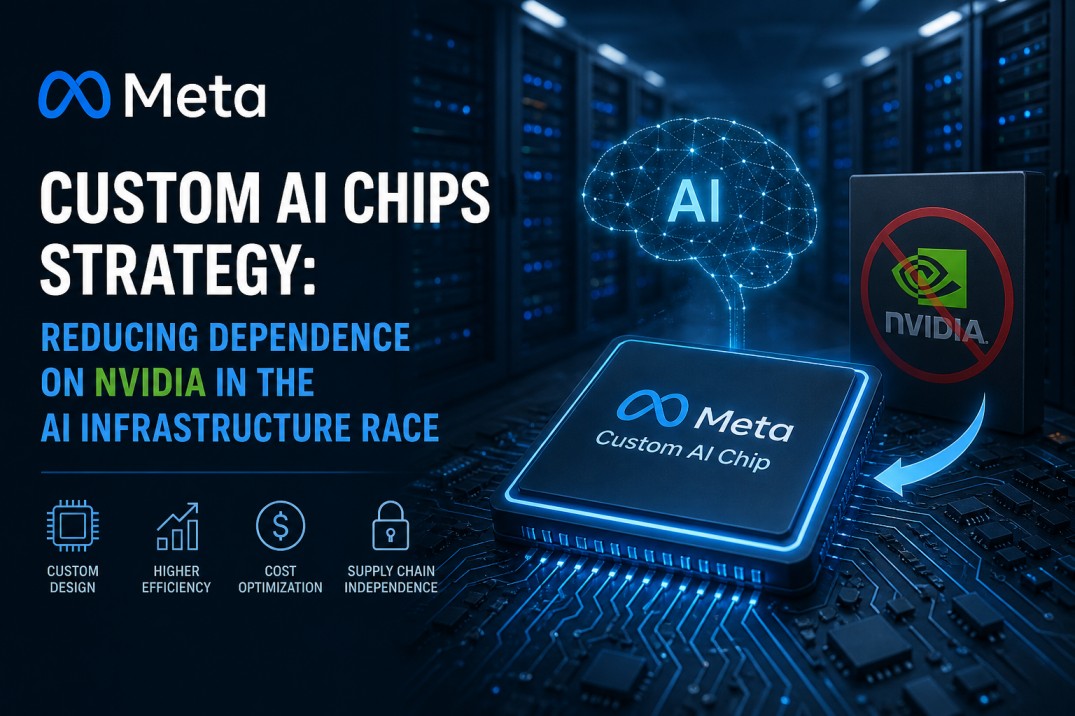
Meta is developing custom AI chips to reduce reliance on Nvidia GPUs, marking a major shift in the global AI infrastructure landscape as tech giants compete for compute dominance.


Meta’s Shift Toward Custom AI Chips

Meta Platforms is accelerating its development of custom AI chips, known as MTIA (Meta Training and Inference Accelerators), as part of a long-term strategy to reduce reliance on Nvidia GPUs and improve control over its AI infrastructure.

The move reflects a broader shift in the technology industry where companies are increasingly investing in in-house AI silicon development to support massive AI workloads across advertising, recommendation systems, and generative AI.


Why Meta Is Reducing Dependence on Nvidia

Nvidia remains the dominant supplier of AI GPUs, powering most of the world’s large-scale AI training systems. However, Meta’s growing AI demand has led to a strategic diversification of compute infrastructure.

Key Reasons Behind Meta’s Strategy

  • Rising AI infrastructure costs at scale
  • Need for optimized hardware for Meta-specific workloads
  • Reduced dependency on external chip suppliers
  • Improved efficiency for AI inference tasks
  • Long-term infrastructure control and flexibility

Meta continues to use Nvidia GPUs but is gradually balancing its compute stack with internal silicon solutions.


What Are Meta’s MTIA AI Chips?

Meta’s MTIA chips are custom-designed processors built specifically for AI inference and recommendation workloads.

Key Features of MTIA Chips:

  • Optimized for AI inference tasks
  • Designed for ranking, recommendations, and ads
  • Integrated with Meta’s internal AI systems
  • Built for high efficiency at massive scale
  • Evolving rapidly with new generations planned every 6–12 months

Unlike general-purpose GPUs, MTIA chips are purpose-built for Meta’s internal workloads, improving performance and reducing unnecessary computing overhead.


Meta’s Hybrid AI Compute Strategy

Meta is not completely replacing Nvidia. Instead, it is adopting a hybrid AI infrastructure model:

  • Nvidia GPUs for large-scale AI training
  • MTIA chips for inference and internal workloads
  • External partnerships for fabrication and design scaling

This approach allows Meta to balance performance, cost, and supply chain flexibility.


Strategic Partnerships in AI Chip Development

Meta is collaborating with major semiconductor companies to scale its custom silicon roadmap.

Broadcom Collaboration

Meta is working with Broadcom to co-develop next-generation AI chips designed for large-scale deployment across data centers.

Manufacturing Dependence

Even with custom design capabilities, Meta still relies on external foundries such as TSMC for chip production, meaning full vertical integration is not yet achieved.


The Global AI Infrastructure Race

Meta’s chip strategy is part of a wider industry trend where major tech companies are building their own AI hardware ecosystems:

  • Google: Tensor Processing Units (TPUs)
  • Amazon: Trainium and Inferentia chips
  • Microsoft: Maia AI chips
  • Meta: MTIA chips

This marks a shift from GPU dependency toward custom AI silicon ecosystems.


Nvidia’s Position Remains Strong

Despite growing competition, Nvidia continues to dominate the AI hardware market due to:

  • Industry-leading GPU performance
  • CUDA software ecosystem dominance
  • Massive global demand from AI companies
  • Deep integration in AI training pipelines

Meta’s strategy does not replace Nvidia—it diversifies compute dependency.


Impact on the AI Industry

Meta’s move toward custom AI chips signals a major transformation in the AI ecosystem:

1. AI hardware diversification

Multiple chip architectures will coexist in the market.

2. Rise of hyperscaler silicon

Big tech companies are becoming chip designers, not just buyers.

3. Cost optimization becomes critical

Custom chips reduce long-term AI infrastructure costs.

4. Shift from software race to infrastructure race

AI leadership now depends on compute control.


Conclusion

Meta’s investment in custom AI chips highlights a major shift in the AI industry. While Nvidia remains essential, Meta is building internal silicon capabilities to gain greater control over performance, cost, and scalability.

The future of AI infrastructure will not depend on a single chip provider but on a multi-layered ecosystem of custom and commercial silicon solutions.


FAQ

What AI chips is Meta developing?

Meta is developing custom AI chips called MTIA (Meta Training and Inference Accelerators) designed for AI inference, recommendation systems, and internal workloads.

Why is Meta reducing dependence on Nvidia?

Meta is reducing reliance on Nvidia to lower infrastructure costs, improve efficiency, and gain more control over its AI hardware stack.

Will Meta stop using Nvidia GPUs?

No. Meta will continue using Nvidia GPUs for large-scale AI training but will use its own MTIA chips for specific inference workloads.

What are MTIA chips used for?

MTIA chips are used for AI inference tasks such as content ranking, recommendation systems, and advertising optimization within Meta’s platforms.

How does Meta’s chip strategy compare to Google and Amazon?

Like Google (TPUs) and Amazon (Trainium), Meta is building custom AI chips to reduce dependency on external GPU providers and optimize internal workloads.

Is Nvidia losing its dominance in AI chips?

Not currently. Nvidia still dominates the AI GPU market, but competition is increasing as major tech companies develop their own custom silicon solutions.


Post Views: 140
Tagged: AI accelerator architecture Meta AI accelerators Meta AI capex semiconductor AI chip competition Meta Nvidia AI chip ecosystem evolution AI chip investment trends AI chip market competition AI chip monopoly Nvidia AI chip supply chain AI chip war between tech giants AI compute cost reduction AI compute dominance war AI compute efficiency per watt AI compute infrastructure AI data center chips Meta AI data center expansion Meta AI hardware industry future trends AI hardware market shift AI hardware optimization AI hardware race AI hardware vendors competition AI hardware-software co-design AI inference acceleration chips AI inference chips vs training chips difference AI inference latency reduction AI infrastructure competition 2026 AI infrastructure optimization layer AI infrastructure spending 2026 AI infrastructure war AI memory bandwidth bottleneck AI model inference hardware AI model serving infrastructure AI rack-scale architecture AI ranking system hardware AI recommendation system chips AI scalability infrastructure AI semiconductor competition AI semiconductor giants AI silicon innovation AI training vs inference chips AI workload optimization chips AI workload segmentation Amazon Trainium chips AMD AI chips Meta partnership application specific integrated circuits AI ASIC vs GPU AI workloads benefits of Meta custom silicon strategy big tech AI silicon race Broadcom AI chip collaboration chiplet architecture AI chiplet-based AI design cloud AI infrastructure chips cloud computing AI chips cloud providers AI chips CUDA alternative chips custom AI chips Meta custom silicon vs GPUs for AI deep learning chip architecture distributed AI training systems edge AI vs data center AI energy efficient AI chips exaflop AI computing systems feed ranking algorithms Meta FP8 AI computation future of AI hardware industry generative AI infrastructure global AI chip ecosystem GPU supply constraints AI GPU vs ASIC AI performance high bandwidth memory AI chips how Meta AI chips work hyperscaler AI chip strategy explained hyperscaler AI chips hyperscaler chip race 2026 hyperscaler silicon strategy impact of Meta AI chips on Nvidia stock inference-first AI chip design large scale AI computing Meta Llama model hardware optimization low precision AI computing machine learning hardware Meta Meta AI chip development Meta AI chip performance improvements Meta AI chip roadmap 2026 2027 Meta AI chips Meta AI hardware strategy Meta AI infrastructure Meta AI infrastructure cost reduction strategy Meta artificial intelligence chips Meta chip design strategy Meta custom AI silicon Meta data center AI chips Meta MTIA chips Meta MTIA vs Nvidia GPUs comparison Meta Nvidia dependence Meta reducing Nvidia dependence explained Meta silicon strategy Meta training and inference accelerator Meta vs Google TPU Meta vs Nvidia AI chips Microsoft Maia AI chips MTIA chips explained MTIA chips use cases explained neural network acceleration hardware next generation AI infrastructure next-gen AI chip roadmap Nvidia Blackwell GPU alternative Nvidia GPU alternative PyTorch AI hardware support recommendation engine AI chips RISC-V AI processors semiconductor AI race silicon independence strategy transformer model inference optimization Triton compiler AI chips TSMC AI chips vertically integrated AI stack why companies are building custom AI chips why Meta is building its own AI chips will Meta replace Nvidia chips

Post navigation

Previous: PlayStation 6 Leaks: Everything We Know So Far About Sony’s Next-Gen Console
Next: Apple Q2 2026 Earnings: $111.2B Revenue, iPhone Surge and Services Hit Record High

Leave a Reply Cancel reply

Your email address will not be published. Required fields are marked *

Related News

Apple Q2 2026 Earnings

Apple Q2 2026 Earnings: $111.2B Revenue, iPhone Surge and Services Hit Record High

Dawa14 hours ago14 hours ago 0
GoPro Mission 1 Pro Ultimate Creator

GoPro Mission 1 Pro Ultimate Creator Review: The Complete Filmmaking Kit in One Package?

Dawa7 days ago4 days ago 0
  1. P999 on Oppo Reno 12 5G specifications and features!May 2, 2026

    Great overview of the Oppo Reno 12 5G! I'm particularly impressed with its camera capabilities and design. Does anyone have…

  2. svip5 on vivo V23 5G, the Color-Changing Phone with Dual Selfie Camera has launched in Nepal: price and specsApril 28, 2026

    The Vivo V23 5G sounds exciting with its unique color-changing feature and dual selfie cameras! I'm curious to see how…

  3. free crm on OPPO A16k Launched in Nepal: Price, Specs, and FeaturesApril 26, 2026

    Good post! We will be linking to this particularly great post on our site. Keep up the great writing

  4. Lucas Richardson on Sony Raises PlayStation 5 Prices Globally, PS5 Pro Now $899.99April 22, 2026

    Solid content—no fluff, just value.

  5. Eve Johnson on HP HyperX OMEN Max 16 (Spring 2026) Review: The 300W Gaming Monster Redefining Laptop PowerApril 15, 2026

    ok

Follow Us on

Category Collection

AI10 News
Apple50 News
Fintech151 News
News637 News

Nepal's go-to platform for tech news and updates. We want to be your Tech Sathi.
©Copyright 2025 techsathi. com All Rights Reserved. Designed & Developed by techsathi team

  • About Us
  • Advertise
  • Contact Us
  • Homepage
  • Privacy Policy
  • Submit Article

New Arrivals

  • Apple Q2 2026 Earnings: $111.2B Revenue, iPhone Surge and Services Hit Record High
  • Meta’s Custom AI Chips Strategy: Reducing Dependence on Nvidia in the AI Infrastructure Race
  • PlayStation 6 Leaks: Everything We Know So Far About Sony’s Next-Gen Console
  • GoPro Mission 1 Pro Ultimate Creator Review: The Complete Filmmaking Kit in One Package?
  • GoPro Mission 1 Pro ILS Review: GoPro’s First Interchangeable Lens Cinema Camera

Highlights

  • Apple
  • News
  • Apple
  • News

Apple Q2 2026 Earnings: $111.2B Revenue, iPhone Surge and Services Hit Record High

3 days ago3 days ago
  • News
  • News

Meta’s Custom AI Chips Strategy: Reducing Dependence on Nvidia in the AI Infrastructure Race

3 days ago3 days ago
  • Sony
  • Sony

PlayStation 6 Leaks: Everything We Know So Far About Sony’s Next-Gen Console

3 days ago3 days ago
  • GoPro
  • News
  • GoPro
  • News

GoPro Mission 1 Pro Ultimate Creator Review: The Complete Filmmaking Kit in One Package?

3 days ago3 days ago