
Stanford University’s 2026 AI Index Report has officially arrived — and it paints the clearest picture yet of how rapidly artificial intelligence is transforming the world.
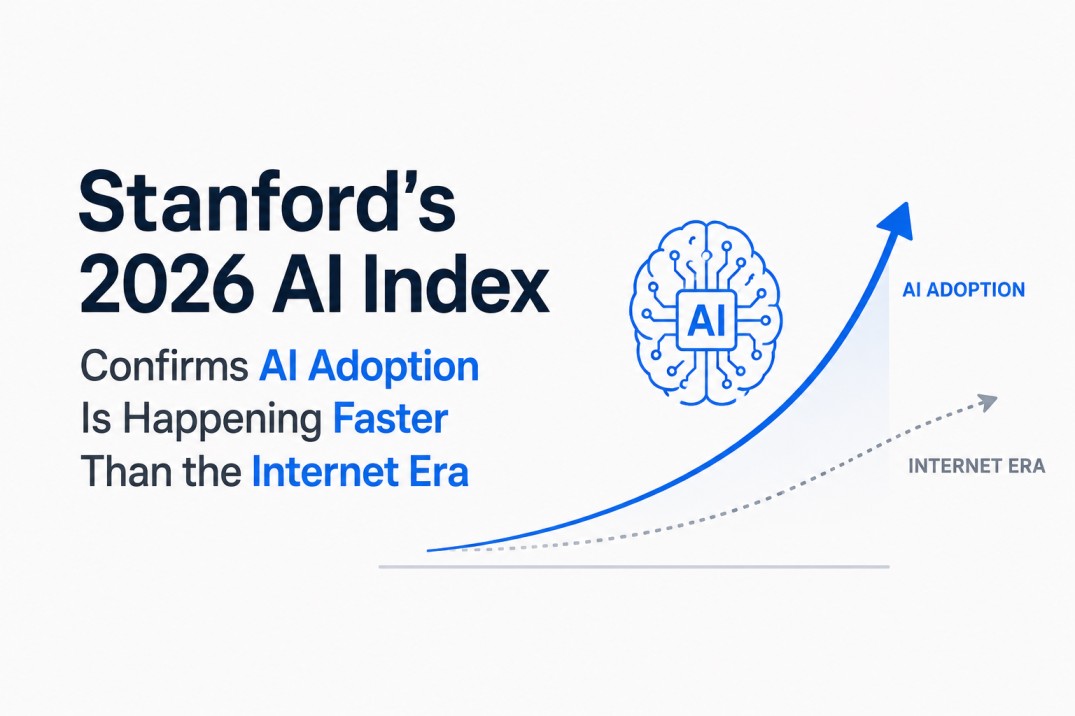
From explosive enterprise adoption to the intensifying global AI race between U.S. and Chinese labs, the report highlights a reality that is becoming impossible to ignore: AI adoption is accelerating faster than the personal computer and internet revolutions ever did.
AI Adoption Is Growing at Historic Speed
According to the latest report from Stanford Human-Centered Artificial Intelligence, generative AI has reached 53% population adoption within just three years, surpassing the adoption speed of both the personal computer and the internet.
The report also reveals:
- 88% of organizations now use AI in at least one business function
- Four in five university students use generative AI tools for academic work
- AI capability continues accelerating rather than slowing down
This marks one of the fastest technological adoption cycles ever recorded.
Anthropic Leads AI Model Rankings in 2026
One of the biggest revelations in the report is the changing balance of power in frontier AI models.
As of March 2026:
- Anthropic leads the AI model rankings
- xAI, Google AI, and OpenAI follow closely behind
- Chinese AI firms including DeepSeek and Alibaba Cloud AI are only modestly behind top U.S. models
The report states that the performance gap between U.S. and Chinese AI models has narrowed to just 2.7%, signaling that the global AI race is becoming increasingly competitive.
The AI Industry Is No Longer Dominated by Academia
Another major trend highlighted in the report is the growing dominance of private companies in AI development.
Stanford’s findings show:
- More than 90% of notable frontier AI models released in 2025 came from industry rather than universities or public research labs
- Major AI companies are becoming increasingly secretive about training data, compute size, and model architecture
This reflects a broader shift where AI leadership is increasingly tied to:
- Access to massive compute infrastructure
- Proprietary datasets
- Specialized AI chips
- Billion-dollar investment capacity
AI Capabilities Are Accelerating Rapidly
The report emphasizes that AI performance is improving at an extraordinary pace.
Key findings include:
- AI coding benchmark performance jumped from 60% to nearly 100% in one year
- Frontier models now exceed human baselines on several PhD-level science and reasoning benchmarks
- Advanced multimodal AI systems are rapidly improving across mathematics, coding, and scientific reasoning tasks
However, the report also describes modern AI as a “jagged frontier” — highly capable in some tasks while still surprisingly weak in others.
Public Trust in AI Is Falling
Despite record adoption, public trust in AI systems is declining.
The Stanford AI Index notes:
- AI-related incidents and safety concerns are increasing
- Transparency from major AI labs has decreased significantly
- Only a minority of people trust governments to regulate AI effectively
The report highlights a widening gap between AI experts and the general public regarding optimism about AI’s future impact on jobs and society.
AI’s Impact on Jobs Is Already Visible
One of the most discussed findings involves the labor market.
The report shows:
- Employment for software developers aged 22–25 dropped nearly 20% since 2024
- AI tools are significantly increasing productivity
- Entry-level roles appear most vulnerable to automation pressure
At the same time, demand for experienced AI engineers and infrastructure specialists continues to grow rapidly.
The AI Infrastructure War Is Intensifying
The report reinforces a major trend reshaping the tech industry: AI is increasingly becoming an infrastructure competition.
Companies are now competing across:
- AI chips
- Data centers
- Compute power
- Model efficiency
- Energy consumption
- Proprietary AI ecosystems
This helps explain why companies like Meta, Google, Microsoft, Amazon, and OpenAI are investing billions into custom silicon, AI infrastructure, and next-generation data centers.
Conclusion
Stanford’s 2026 AI Index confirms that artificial intelligence is no longer an emerging technology — it is rapidly becoming foundational infrastructure for business, education, software, and global competition.
AI adoption is now moving faster than the internet revolution itself, while the gap between leading AI companies continues shrinking.
The next phase of the AI race may not be decided solely by who builds the smartest model, but by who controls the infrastructure, compute, and ecosystem powering the future of artificial intelligence.
FAQ (SEO Optimized)
What is the Stanford AI Index 2026?
The Stanford AI Index 2026 is an annual report published by Stanford HAI that tracks global trends in artificial intelligence, including adoption, model performance, investment, education, and policy.
How many organizations use AI in 2026?
According to the report, around 88% of organizations now use AI in at least one business function.
Is AI adoption faster than the internet?
Yes. Stanford’s report states that generative AI reached 53% population adoption within three years, faster than both the internet and personal computer eras.
Which company leads AI model rankings in 2026?
As of March 2026, Anthropic leads the AI model rankings, followed closely by xAI, Google, OpenAI, and Chinese firms like DeepSeek and Alibaba.
How close are Chinese AI models to U.S. models?
The report says the performance gap between U.S. and Chinese AI models has narrowed to around 2.7%.
Is AI affecting jobs already?
Yes. The report shows declining employment among younger software developers and increasing automation pressure in entry-level roles.