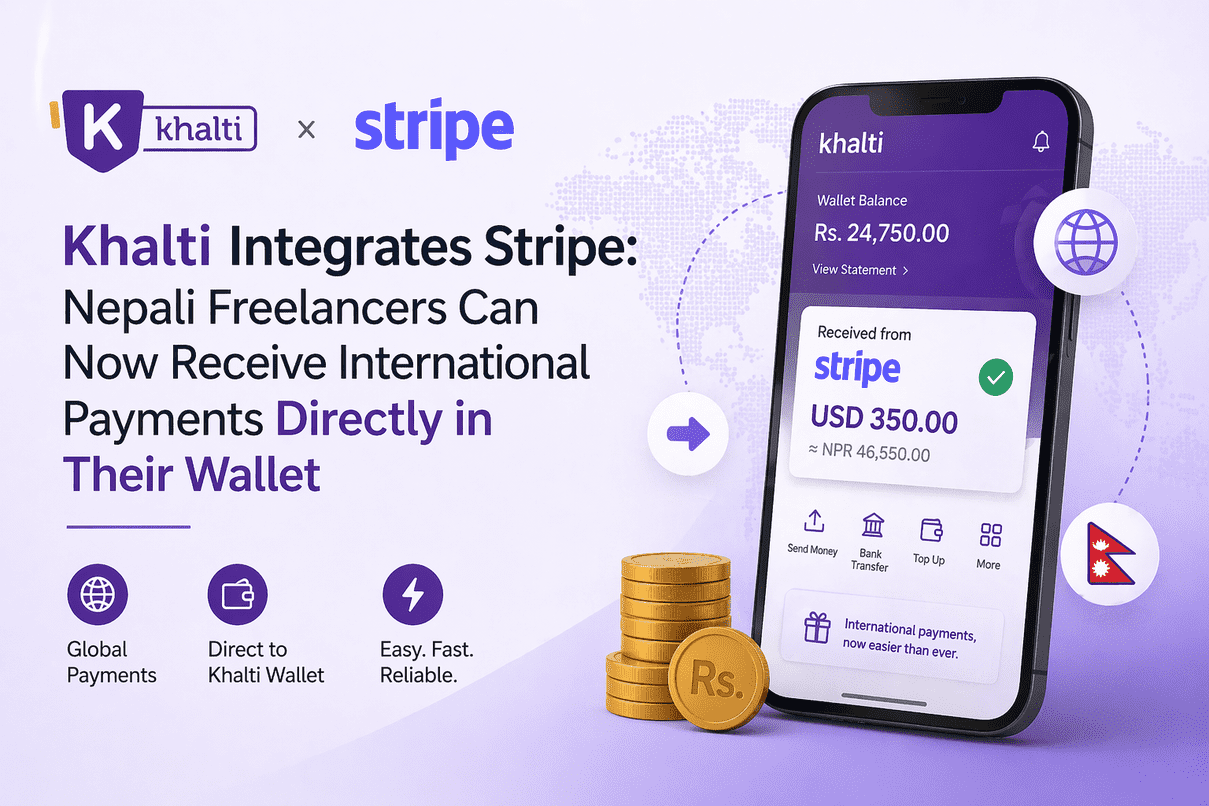
After years of relying on SWIFT codes, intermediaries, and long settlement delays, Khalti by IME has partnered with Stripe to enable Nepali freelancers to receive international payments directly into their wallets in real time.
AT A GLANCE
- Announced: April 20, 2026
- Partnership: Khalti by IME × Stripe
- Who benefits: Freelancers, creators, SMEs, remote workers, families
- Settlement: Real-time into Khalti wallet (NPR)
- Supported payments: Visa, Mastercard, Apple Pay, Google Pay, eBanking
- Coverage: 100+ countries for inbound payments
- Tax (TDS): 5% advance tax auto-deducted (PAN required)
- Foreign account needed: No
- Separate app needed: No
The Problem It Solves
For years, freelancing in Nepal suffered from payment friction rather than a lack of talent. Although Nepali professionals built strong global demand, outdated financial systems slowed down income access.
Previously, freelancers depended on SWIFT transfers, Payoneer, Wise, or informal channels. SWIFT transfers often took weeks and frequently reduced payouts through multiple bank fees. Meanwhile, other platforms introduced extra steps and compliance hurdles.
As a result, despite Nepal’s rapidly growing ICT export sector, many professionals struggled to access their earnings efficiently.
Now, this integration directly addresses that gap.
What Just Happened
On April 20, 2026, Khalti by IME announced a strategic partnership with Stripe that allows Nepali users to receive international payments directly into their Khalti wallets.
Importantly, the system removes multiple intermediaries and simplifies cross-border payments into a single streamlined flow. Users generate a payment request inside the app, share it globally, and receive funds in real time.
Moreover, the platform automatically converts incoming payments into Nepalese Rupees (NPR), eliminating manual exchange steps.
How It Works
For freelancers in Nepal:
First, users update the Khalti app. Then, they complete International Payment KYC as required by Nepal Rastra Bank. After that, they access the Stripe feature inside the app.
Next, users enter payment details such as currency, amount, and client email. Then, they generate a secure payment link and share it with the client.
For international clients:
Clients open the link and access a secure checkout page. They can pay using Visa, Mastercard, Apple Pay, Google Pay, or eBanking options.
Importantly, clients do not need a Stripe account or a business setup. Instead, they complete a simple one-time verification during their first transaction.
After that, future payments process much faster.
Payment flow:
Once the client completes payment, Khalti immediately receives the funds and converts them into NPR. Finally, the amount reflects directly in the user’s wallet.
Fees and Tax Structure
Khalti applies a structured deduction system before final payout. Specifically, three components determine the final amount:
- A service fee based on transaction size
- Currency conversion into NPR at prevailing rates
- A 5% advance tax deducted automatically
In addition, users must provide a PAN (Permanent Account Number) to comply with tax regulations.
Furthermore, under current rules, IT-related service exports may qualify for simplified taxation, although classification depends on the nature of the work performed.
Who This Is For
This system supports a wide range of users. In particular, it benefits:
- Freelancers and consultants working with global clients
- Content creators and streamers earning internationally
- SMEs expanding into foreign markets
- Remote workers receiving overseas payments
- Families receiving remittances from abroad
- Tourism businesses such as hotels and trekking agencies
How It Compares to Previous Options
Earlier, freelancers relied on fragmented systems that created friction and delays.
For example, SWIFT transfers delivered funds slowly and incurred high fees. Similarly, Payoneer added withdrawal steps, while Wise introduced account restrictions in some cases. Meanwhile, informal channels exposed users to financial risks.
In contrast, the Khalti-Stripe integration consolidates the entire process into a single workflow. As a result, users generate a link, share it, and receive funds instantly in NPR without intermediaries.
Security
Stripe secures transactions using global fraud detection systems and encrypted payment infrastructure. At the same time, Khalti operates under regulated financial frameworks with ISO-certified systems.
Together, both platforms ensure secure and compliant cross-border transactions.
Why This Matters
This partnership significantly strengthens Nepal’s digital economy. By removing structural barriers, it enables faster global payments and improves financial access for freelancers and businesses.
Additionally, it increases client trust because international buyers interact with a globally recognised checkout experience.
Consequently, Nepali professionals can compete more effectively in global markets without relying on external banking systems.
Limitations
However, the system still has certain constraints:
- It supports inbound payments only
- KYC verification remains mandatory
- PAN is required for tax processing
- All settlements occur in NPR only
- Tax treatment varies depending on work type
Frequently Asked Questions
No. Khalti integrates Stripe internally, so users do not need a separate account
No. Clients simply pay through a secure checkout page without any registration.
Payments arrive instantly after the client completes the transaction.
All funds convert automatically into Nepalese Rupees before reaching the wallet.
Yes. Khalti deducts a 5% advance tax automatically when PAN is provided.
Yes. Freelancers, SMEs, and tourism operators can all use the system.
No. The system currently supports only inbound payments.
The Bottom Line
This integration marks a major shift in Nepal’s digital payments landscape. By combining global payment infrastructure with a local wallet system, Khalti and Stripe have simplified cross-border income collection.
As a result, freelancers no longer wait weeks for payments or rely on multiple intermediaries. Instead, they generate a link, share it globally, and receive funds instantly in NPR.