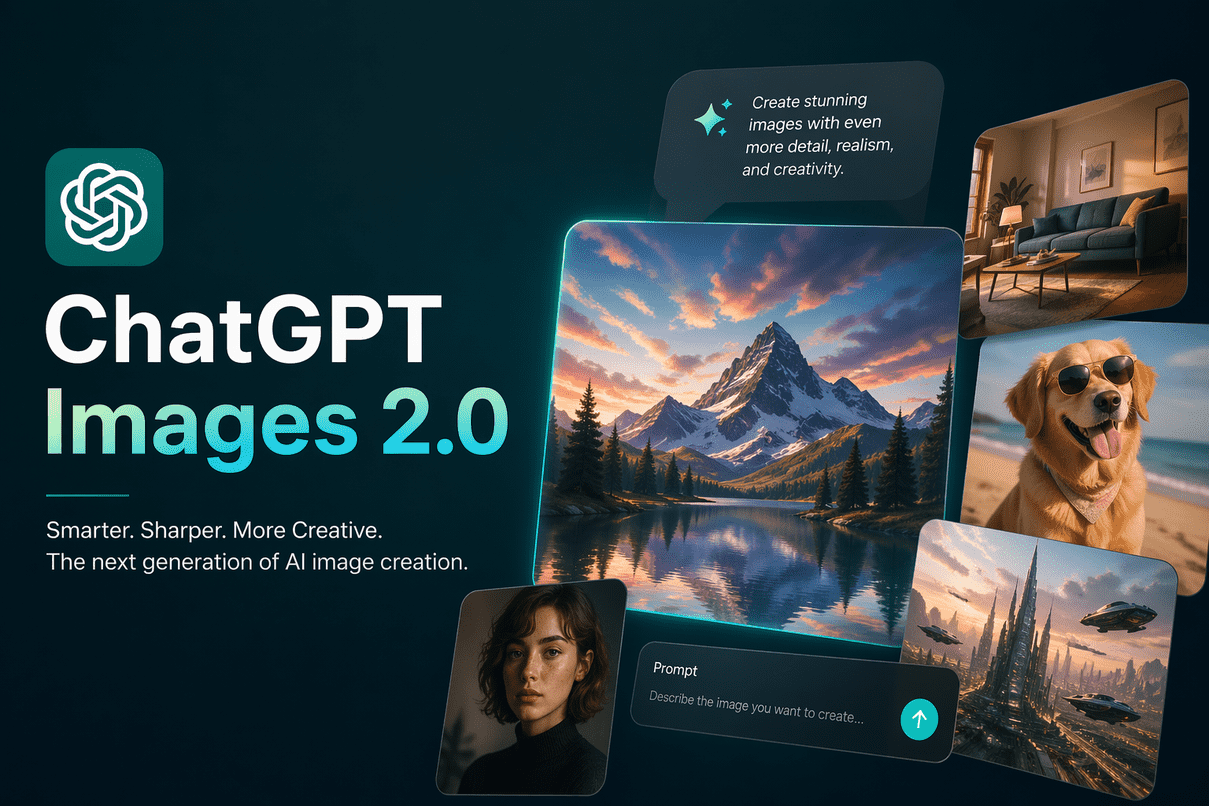
OpenAI’s ChatGPT Images 2.0 has arrived with advanced reasoning capabilities, near-perfect text rendering, and widespread accessibility. It is already sparking debate across the design industry about how much entry-level creative work may be reshaped by AI.
AT A GLANCE
- Model: ChatGPT Images 2.0 (GPT-4o reasoning architecture)
- Launch Date: April 21, 2026
- Free Access: Yes (Instant mode)
- Paid Plan: $20/month (Thinking mode + advanced features)
- Text Accuracy: ~99% across multiple scripts
- Benchmark Ranking: #1 on Image Arena (record +242 point lead)
- Key Impact Area: Junior design, marketing assets, UI mockups
What Just Happened?
A major shift in AI-generated design quietly unfolded this week. While users experimented with playful image prompts, the deeper implication was far more significant: ChatGPT Images 2.0 is no longer just a generative tool — it is a reasoning-based creative system.
Unlike earlier models, it does not simply generate visuals from prompts. Instead, it plans compositions, evaluates spatial relationships, and can even incorporate real-time web context before producing an image.
Within 12 hours of release, the model reached the top position on the Image Arena leaderboard, setting a new record margin.
How ChatGPT Images 2.0 Works
The system operates in two distinct modes, each designed for different levels of complexity and user needs.
Instant Mode (Free Access)
Instant mode focuses on speed and usability:
- Generates images from natural language prompts
- Edits existing images (background removal, style changes)
- High-accuracy text rendering across scripts
- Faster output compared to previous models
- Supports multiple aspect ratios
This mode is designed for everyday users and quick content creation.
Thinking Mode (Plus Subscription – $20/month)
Thinking mode introduces structured reasoning before generation:
- Performs web-based research before creating visuals
- Produces multiple variations in a single prompt
- Verifies composition before final output
- Creates storyboards, comics, and sequential layouts
- Generates QR codes embedded within designs
- Produces full marketing asset bundles (social, web, print)
- Supports identity consistency through likeness upload
This mode is significantly slower but far more precise and strategic.
Free vs Paid Access Breakdown
| Feature | Free | Plus ($20/month) |
|---|---|---|
| Image generation | Limited | Unlimited |
| Instant mode | Yes | Yes |
| Thinking mode | No | Yes |
| Web search | No | Yes |
| Batch generation | No | Yes |
| Multi-size export | No | Yes |
| QR code generation | No | Yes |
| Likeness consistency | No | Yes |
Is This the End for Junior Graphic Designers?
The concern circulating in design communities is understandable, but the reality is more nuanced.
What is directly affected
Routine production work is the most exposed area. Tasks such as resizing assets, creating social media variations, and assembling basic marketing visuals can now be automated in seconds. A single prompt can replace hours of repetitive design execution.
What remains human-driven
Strategic and conceptual work still requires human judgment:
- Brand identity development
- Creative direction and storytelling
- Client communication and interpretation
- Aesthetic decision-making beyond pattern generation
The shift is less about elimination and more about compression of entry-level roles.
The New Skill Set for Designers
Design roles are evolving toward hybrid creative-technical expertise. Key skills now include:
- Prompt-based visual direction
- AI output evaluation and refinement
- Brand system development
- Creative strategy translation
- Quality control and consistency management
Designers are increasingly becoming art directors of AI systems rather than manual creators.
What the Model Still Cannot Do Well
Despite its capabilities, limitations remain:
Knowledge limitations
The model relies on a cutoff of December 2025 and may require web integration for current accuracy.
Brand consistency challenges
Long-term campaign coherence still requires human oversight and structured design systems.
Legal uncertainty
Copyright and licensing frameworks for AI-generated content remain inconsistent across jurisdictions.
Edge-case visual errors
Complex anatomy, fine detail accuracy, and multi-subject scenes may still produce inconsistencies.
Frequently Asked Questions
Yes. Free users get access to Instant mode with usage limits. Advanced features require Plus.
It is a reasoning layer that plans and verifies image generation before producing outputs.
It can automate production tasks but not strategic or creative leadership roles.
Yes, under OpenAI’s current terms, though legal interpretations vary by region.
It leads in instruction accuracy and text rendering, while other tools may still excel in artistic style or ecosystem integration.
Bottom Line
ChatGPT Images 2.0 represents a shift from image generation to image reasoning. The barrier to producing professional-looking visuals has dropped significantly, changing expectations across creative industries.
For junior designers, this means fewer traditional production roles. For experienced creatives, it opens opportunities to focus more on strategy, direction, and system design.
The core question is no longer whether AI can design — but how designers will redefine their value in an AI-assisted workflow.
Tags: AI, OpenAI, ChatGPT Images 2.0, graphic design, automation, GPT-4o, creative industry
Disclaimer: This article is informational and reflects current AI capabilities as of April 2026. Features and pricing may change.