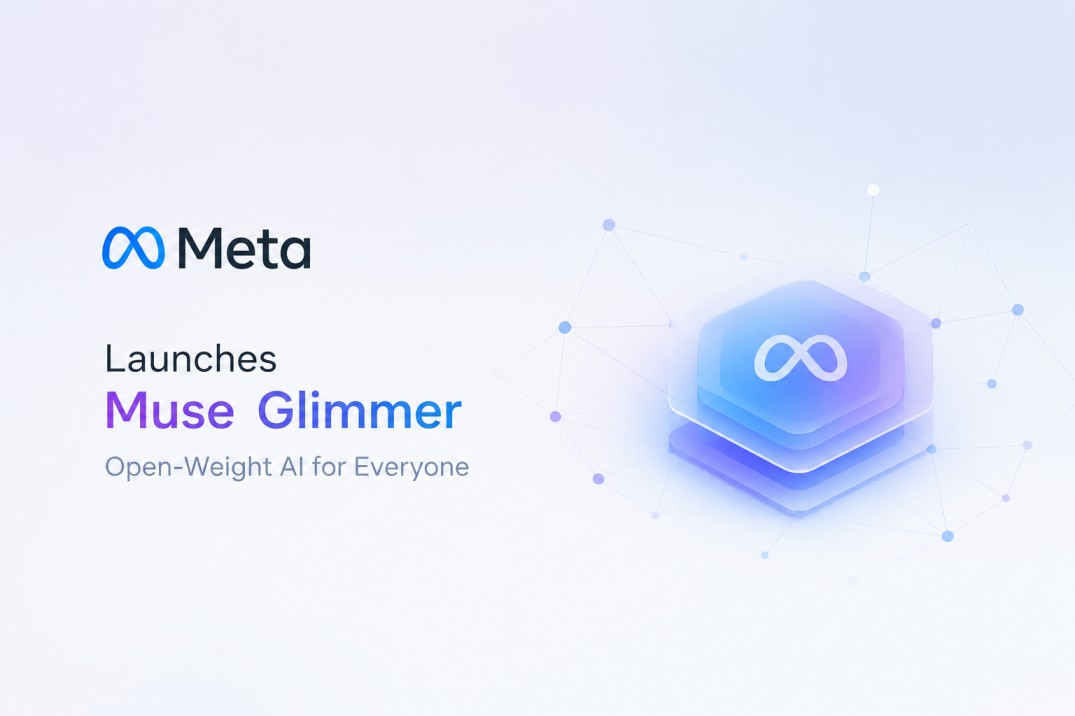
Meta is making a significant shift in its artificial intelligence strategy with the release of Muse Glimmer, a 30-billion-parameter open-weight model designed specifically for local AI agents.
The launch comes alongside a lengthy essay from Meta CEO Mark Zuckerberg, who renewed his argument that advanced AI should remain widely accessible rather than being controlled by a small group of technology companies.
The combination of the model release and Zuckerberg’s policy argument signals a broader ambition: move more capable AI from centralized cloud infrastructure to personal devices while keeping the underlying technology accessible to developers.
What Is Meta Muse Glimmer?
Muse Glimmer is a 30-billion-parameter dense AI model built for agentic workloads. Meta says it can run on a single GPU and is optimized for tasks that require tool use, long-running workflows, planning, and recovery from failures.
Unlike conventional chatbot models that primarily generate responses, Glimmer is designed to work as an AI agent. That means it can be integrated into workflows where the model needs to plan actions, use tools, check results, and continue working toward a goal.
Meta has released the model under the Apache 2.0 license, making its weights broadly available for developers to download, adapt, and deploy within the license terms.
Key Highlights of Muse Glimmer
| Feature | Muse Glimmer |
|---|---|
| Parameters | 30 billion |
| Model type | Dense |
| Primary focus | Local AI agents |
| Hardware | Designed to run on a single GPU |
| License | Apache 2.0 |
| Main capabilities | Tool use, planning, long tasks, failure recovery |
| Deployment | Local and developer environments |
Why Local AI Matters
Most advanced AI services currently depend on cloud infrastructure. Users send requests to remote servers, where powerful GPUs process them before returning a response.
Muse Glimmer takes a different approach.
By running the model locally, developers can build AI applications that rely less on remote inference. This could be particularly useful for applications that handle sensitive information or need to operate with limited connectivity.
Local AI can also reduce recurring API and cloud-computing costs.
However, running a 30-billion-parameter model still requires capable hardware. The technology does not eliminate the need for powerful computers; instead, it aims to make advanced AI more accessible outside massive data centers.
Meta Plans to Open Muse Spark 1.2
Meta’s announcement extends beyond Glimmer.
The company has also committed to releasing the open weights of Muse Spark 1.2, its more powerful AI model. The announcement is significant because Spark 1.2 currently represents a much larger part of Meta’s frontier AI strategy.
If Meta follows through, developers will gain access to a considerably more capable model without having to rely exclusively on Meta’s hosted services.
The release could therefore become one of the most important developments in the current open-weight AI ecosystem.
Zuckerberg’s Case for Open-Weight AI
Alongside Muse Glimmer, Zuckerberg published a roughly 6,500-word essay titled “The Future Is for Everyone.”
His argument is straightforward: AI should not become concentrated within a handful of corporations or institutions.
Zuckerberg believes open-weight models can distribute AI capabilities more broadly. Developers, businesses, researchers, and individuals can build on the models instead of depending entirely on closed AI platforms.
He also argues that open AI can help maintain a balance of technological power and strengthen the United States’ position in the global AI race.
Meta’s Vision for Personal AI
The broader strategy is about more than making models downloadable.
Meta increasingly sees AI agents as personal computing assistants capable of interacting with software, organizing information, completing tasks, and assisting users across different parts of their digital lives.
Glimmer’s local-first design fits directly into that vision.
Imagine an AI assistant that can work with your files, applications, calendar, and other local information without sending every interaction to a remote server. That could provide greater privacy and potentially lower operating costs.
It also changes the role of the personal computer.
A future laptop may not simply run applications. It could continuously run AI agents that understand the user’s environment and perform tasks on their behalf.
Open-Weight Does Not Mean Risk-Free
Meta’s approach also faces criticism.
Giving developers access to powerful model weights makes experimentation easier, but it can also make safeguards more difficult to enforce. Once weights are distributed, the original developer has less control over how others modify or deploy the model.
Critics therefore argue that openness must be balanced against risks involving cybersecurity, misuse, privacy, and increasingly capable autonomous systems.
This creates one of the central debates in AI today:
Should powerful AI be controlled by a small number of organizations, or should its capabilities be distributed more broadly?
Zuckerberg clearly favors the second approach.
Why This Matters for the AI Industry
Meta’s move comes as competition between open and closed AI models intensifies.
Companies such as OpenAI and Anthropic have built businesses around proprietary models and cloud-based services. At the same time, open-weight models have gained significant momentum because they give developers greater control over deployment and customization.
Meta can also benefit strategically from this approach.
Instead of requiring every developer to use a Meta-hosted AI service, the company can make its models part of the infrastructure developers choose when building their own products.
That could give Meta influence across the AI ecosystem even when its models are running outside Meta’s own platforms.
The Bigger Picture
Muse Glimmer represents an important shift toward local, agentic AI.
The model is not simply designed to answer questions. Meta is positioning it as a foundation for AI agents that can plan, use tools, perform extended tasks, and operate directly on consumer hardware.
The upcoming open-weight release of Muse Spark 1.2 could take that strategy even further.
If Meta succeeds, the next stage of AI development may involve a combination of powerful cloud models and increasingly capable local agents running on PCs, smartphones, and other personal devices.
For users, that could mean more private and personalized AI. For developers, it could mean fewer barriers to building sophisticated AI products.
And for Meta, it represents a renewed attempt to make open-weight AI a central force in the industry’s next chapter.