
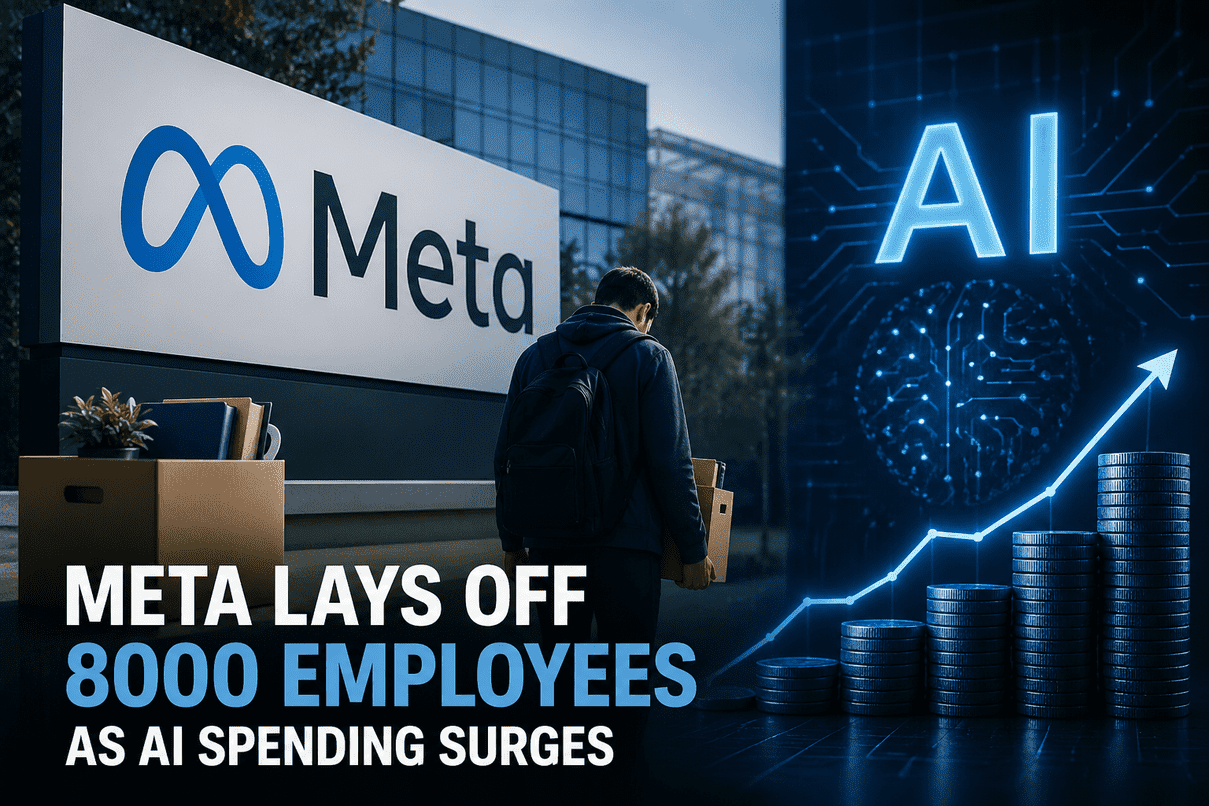
Meta Lays Off 8000 Employees, which equals about 10% of its workforce. At the same time, the company has canceled plans to fill 6,000 open roles.
As a result, nearly 14,000 positions will disappear from Meta’s hiring plans in 2026. The layoffs will begin on May 20 and will roll out in phases.
This move marks Meta’s biggest workforce reduction in three years. However, the decision is not about survival — it reflects a strategic shift.
AI Investment Is Driving the Change
CEO Mark Zuckerberg has made artificial intelligence the company’s top priority. As AI capabilities improve, Meta continues to invest heavily in infrastructure.
In 2025, the company spent $72.2 billion on data centers and AI systems. Now, it plans to increase that spending to between $115 billion and $135 billion in 2026.
Meanwhile, Meta continues to report strong financial results. Revenue and profits remain high, which clearly shows that these layoffs are not caused by financial pressure.
Instead, the company is redirecting money from salaries to AI development.
“We’re starting to see projects that used to require big teams now be accomplished by a single very talented person,” Zuckerberg said earlier this year.
Which Jobs Are Most Affected
The layoffs follow a clear pattern. Meta is reducing roles that AI can now handle more efficiently.
For example, the company is cutting jobs in:
- Content moderation
- Recruiting
- Customer support
- Sales and operations
- Engineering support
In particular, AI systems now manage large parts of content moderation. As a result, fewer human moderators are needed.
Additionally, these changes affect contractors and partner companies that depend on Meta’s operations.
New AI Roles Are Expanding
While some roles are disappearing, new opportunities are also emerging. Meta is actively building teams focused on artificial intelligence.
These new roles include:
- AI Builders
- AI Pod Leads
- AI Organization Heads
At the same time, the company has already moved about 1,000 employees into AI-focused positions.
Therefore, the shift is not just about cutting jobs — it is also about reshaping the workforce.
Leadership Shift Toward AI
Alexandr Wang now leads Meta’s AI strategy. As the head of Superintelligence Labs, he plays a key role in the company’s transformation.
His leadership highlights Meta’s long-term focus on AI innovation. Moreover, it shows how seriously the company is investing in this space.
Not a Financial Crisis
Many people assume layoffs happen during financial struggles. However, that is not the case here.
Meta continues to perform strongly, with growing revenue and record profits. Therefore, the company is not cutting costs to survive.
Instead, it is making a deliberate decision to invest more in AI and less in traditional roles.
A Broader Industry Shift
Meta is not alone in this transition. Other major tech companies are making similar moves.
Companies like Amazon, Alphabet, and Microsoft are also increasing AI spending while reducing workforce size.
In total, these companies plan to invest over $600 billion in AI infrastructure in 2026.
As a result, the entire tech industry is moving in the same direction.
What This Means for Workers
This shift is already changing the job market. Some roles are becoming less relevant, while others are growing in demand.
Jobs at higher risk:
- Repetitive tasks
- Entry-level IT roles
- Data entry
- Basic coding
- Customer support
Jobs in demand:
- AI development
- Strategic roles
- Creative leadership
- AI system management
At the same time, companies are hiring more AI specialists. Meanwhile, traditional tech roles are declining.
Key Takeaways
- Meta will cut 8,000 jobs and cancel 6,000 roles
- AI investment is the main reason behind the layoffs
- The company remains financially strong
- Many affected roles involve tasks AI can automate
- New AI-related jobs are increasing
- The trend is happening across the tech industry
The Bottom Line
Meta’s latest layoffs clearly show how fast the workplace is changing.
This shift is not temporary. Instead, it reflects a long-term transformation driven by artificial intelligence.
For workers, the message is simple: adapting to AI is now essential. Those who build relevant skills will have more opportunities in the future.