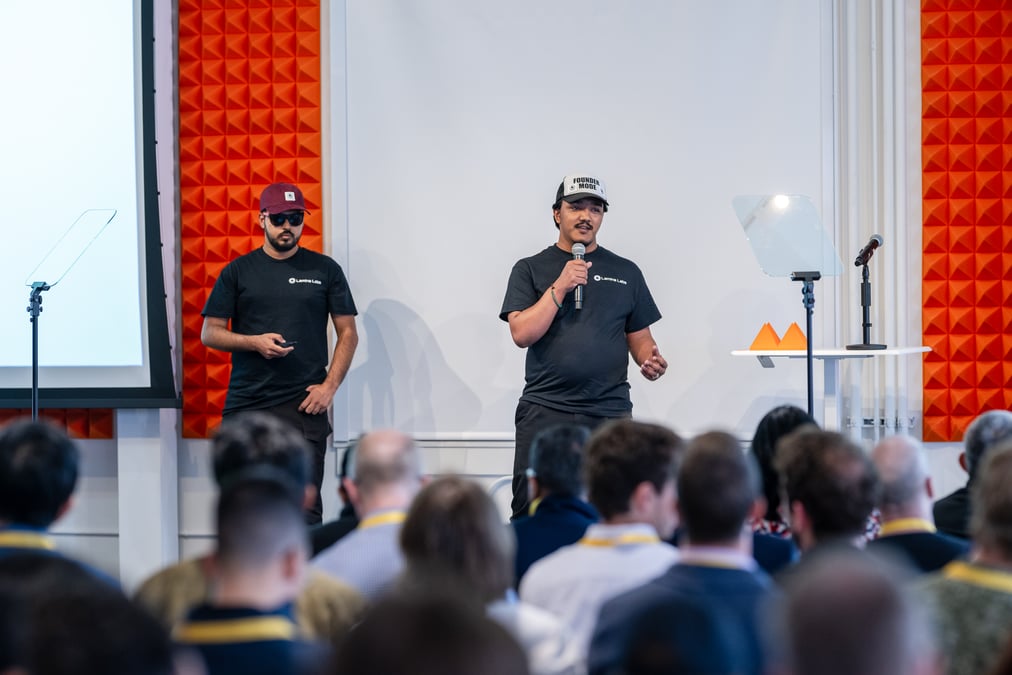
A young Nepali-founded AI startup (Lamina Labs) is gaining international attention after raising $4.8 million to build a new generation of AI-powered video infrastructure.
It is founded by Nepali entrepreneurs Sudip Rokaya and Kartikesh Mishra, is developing technology that turns text, documents and AI-generated answers into short, narrated explainer videos. The company is now based in San Francisco and has become one of the most notable recent examples of Nepali founders building for the global technology market.
From Nepal to MIT and Silicon Valley
Lamina Labs’ story began with two Nepali students who eventually met at the Massachusetts Institute of Technology (MIT).
Sudip Rokaya studied computer science and mathematics at MIT and has a background in machine learning research. He also represented Nepal at the International Olympiad on Astronomy and Astrophysics.
Kartikesh Mishra studied electrical engineering and computer science at MIT and completed his bachelor’s and master’s degrees there. He now serves as its co-founder and CTO.
The two eventually began working together on the idea that became Lamina Labs.
Their focus was not simply to create another AI video generator. Instead, they wanted to build infrastructure that could make useful, educational and explanatory videos quickly enough to be generated almost in real time.
Lamina Labs Becomes the First All-Nepali YC Founding Team
One of the biggest milestones came in 2026 when it was accepted into Y Combinator’s Spring 2026 batch.
According to Y Combinator and the founders, it is the first all-Nepali founding team to go through the prestigious accelerator.
Y Combinator’s standard investment for companies in its current program totals $500,000, giving it both funding and access to one of Silicon Valley’s largest startup networks.
The founders have said that the accelerator’s network and mentorship were particularly valuable. Their YC experience also helped connect the company with investors and potential customers.
$4.8 Million Raised
Following its Y Combinator investment, Lamina Labs secured an additional $3 million in follow-on funding, bringing the reported total capital raised to $4.8 million.
The company’s investors include Y Combinator and Foundation Capital, among other investors backing its effort to build video infrastructure for AI applications. Link Ventures also lists Lamina Labs in its 2026 portfolio and describes the company as building a visual output layer for AI.
The funding is expected to help Lamina Labs expand its engineering team and scale Simi as the company targets global customers.
Meet Simi: AI That Explains Through Video
Lamina Labs’ first product is called Simi.
The idea is straightforward: instead of receiving a long text response from an AI system, users can provide a prompt, document or script and receive a whiteboard-style narrated explainer video.
Simi is designed for educational content, training, product explanations and other situations where visual communication can make complicated information easier to understand.
According to Lamina Labs, Simi supports more than 80 languages and can generate a complete explainer video in seconds. The company says its fastest generation tier can produce videos in under 20 seconds.
What Can Simi Be Used For?
Lamina Labs is targeting several use cases rather than focusing solely on entertainment.
Education
Teachers and EdTech companies can use Simi to turn lessons and complex concepts into visual explanations.
Corporate Training
Companies can create training videos from internal documents, instructions and workflows without relying on traditional video-production teams.
Product Explainers
Startups can turn product documentation or feature descriptions into videos that are easier for customers to understand.
Content Creation
Creators can generate narrated educational videos without spending hours writing scripts, recording voiceovers and editing animations.
This focus separates Simi from many AI video generators that primarily target cinematic footage, advertisements and entertainment.
Why Lamina Labs Is Different
The AI video market is already crowded.
However, Lamina Labs is taking a different approach. The company describes itself as building “video infrastructure for LLMs”, rather than simply building another cinematic video generator.
Most generative video systems focus on producing visually impressive clips. Lamina Labs is focusing on structured video generation where clarity, sequencing, narration and explanation matter more than cinematic realism.
That distinction could become important as AI assistants increasingly move beyond text.
The company’s broader vision is to make video another output format for AI systems, much like text, images and audio are today.
Early Traction
Lamina Labs appears to have gained early traction quickly.
Nepali Times reported that 12 days after Simi’s launch, the platform had around 4,000 users and 187 paying customers. Customers included small businesses and other organizations using the platform for practical educational and explanatory content.
Link Ventures later reported that Lamina Labs had reached more than 190 paying customers within 13 days of launch.
Those early numbers suggest that the company is testing a market beyond the traditional EdTech sector.
A Major Moment for Nepal’s Startup Ecosystem
Lamina Labs’ achievement is significant beyond the company’s funding.
Nepal has produced talented engineers, developers and technology professionals for years. However, relatively few Nepal-founded startups have attracted major Silicon Valley investment while building products for global markets.
Lamina Labs represents a different path.
Two Nepali founders went from Nepal to MIT, then to Silicon Valley, where they built an AI company that secured backing from one of the world’s most influential startup accelerators and additional international investors.
Their success also highlights the increasing ability of small teams to build globally competitive AI products from the start.
What’s Next for Lamina Labs?
With $4.8 million in reported funding, Lamina Labs now has the resources to expand its team, improve Simi and build the infrastructure behind its larger vision.
The company ultimately wants AI systems to generate useful visual explanations on demand.
That could extend beyond whiteboard videos. Product demonstrations, lessons, technical documentation, customer support and enterprise workflows could all potentially become video-based.
For now, Simi is Lamina Labs’ starting point.
But the company’s bigger ambition is much broader: to make video a native interface for AI communication.
A Proud Moment for Nepali Tech
Lamina Labs is still an early-stage company, so its long-term success remains to be seen. Nevertheless, its progress represents a significant milestone for Nepal’s technology ecosystem.
From two Nepali founders meeting at MIT to building an AI startup in San Francisco, joining Y Combinator and raising $4.8 million, Lamina Labs is putting Nepali talent on the global AI map.
And its approach is particularly timely: as AI becomes increasingly capable of generating text and images, Lamina Labs is betting that the next major step is teaching AI to explain ideas through video.