Introduction
Nepal rarely gets to stand alone on a global technology stage. That changed in February 2026, when Nepali AI company Ting Ting represented Nepal as the sole startup at Web Summit Qatar 2026 — one of the world’s largest and most prestigious technology gatherings. The four-day summit in Doha brought together over 1,600 startups from 120 countries and more than 700 world-class investors. Out of thousands of global applicants, Ting Ting earned its place through a rigorous vetting process — not because of funding or foreign backing, but because of the sheer technical merit of technology built entirely on Nepali soil.
For Nepal’s technology community, this moment matters enormously. It demonstrates that innovation does not require Silicon Valley addresses or international venture capital to compete on the world stage. In this article, therefore, we cover everything you need to know about Ting Ting, its technology, what happened at Web Summit Qatar 2026, and why this achievement marks a turning point for Nepal’s tech startup ecosystem.
What Is Ting Ting?
A Nepali AI Communication Company
Ting Ting is an AI-powered business communication company founded less than a year before its Web Summit Qatar debut. Despite its young age, the company has already established itself as a significant player in Nepal’s enterprise communication space. Ting Ting builds under a clear and ambitious philosophy — “Made in Nepal, for the world.” Rather than importing foreign AI solutions and adapting them for local use, Ting Ting develops its technology from the ground up in Nepal, trains it on Nepali language data, and deploys it at enterprise scale.
The Technology Behind the Company
At the heart of Ting Ting’s platform sit two proprietary systems — the RIRI voice engine and the Understanding Engine. The RIRI voice engine handles complex voice telephony at scale, enabling real-time AI-powered voice communication across thousands of simultaneous interactions. The Understanding Engine, meanwhile, processes the meaning behind those interactions — interpreting intent, context, and language nuance rather than simply transcribing words.
Crucially, both systems have been built and trained entirely in Nepal. This matters technically because Nepali is a low-resource language — meaning significantly less training data exists compared to English or Mandarin. Building an AI system that genuinely understands Nepali at enterprise scale therefore represents a meaningful technical achievement, not simply a product launch.
Who Uses Ting Ting in Nepal?
Before going global, Ting Ting first proved its technology at home. The company has deployed its systems across major banks, internet service providers, and government institutions in Nepal — managing complex communication infrastructures at a scale that most Nepali tech startups never reach. Specific deployments include WorldLink, Nepal’s largest ISP, Citizens Bank, eSewa — Nepal’s leading digital wallet — and Dulikhel Municipality for public sector communication initiatives.
Furthermore, Ting Ting delivered Nepal’s first-ever AI-powered mass event information calls for the 1974 AD concert — a landmark moment in national-scale AI communication. As a result, by the time Ting Ting arrived in Doha, it was not presenting a concept or a prototype. It was presenting a proven, deployed system with real enterprise clients and measurable outcomes.
Web Summit Qatar 2026 — What Is It?
Web Summit is one of the world’s most significant technology conferences. Its Qatar edition, held annually in Doha, brings together founders, investors, policymakers, and technology leaders from across the globe. The 2026 edition specifically attracted over 1,600 startups from 120 countries, more than 700 international investors, and companies that collectively represent over USD 463 billion in lifetime funding.
Participation in the startup programme is not open to everyone. Web Summit selects startups through a rigorous global vetting process that assesses technical sophistication, market potential, and the disruptive vision of the company. Consequently, selection alone — before a single presentation is made — serves as a meaningful signal of credibility to international investors and partners.
Furthermore, Web Summit Qatar 2026 reflected the broader momentum in global AI investment. Startups at the summit collectively raised USD 205 million, with AI and machine learning accounting for USD 125 million of that total — underscoring exactly why Ting Ting’s AI-first positioning was well-timed.
What Happened at Web Summit Qatar 2026?
The Startup Showcase
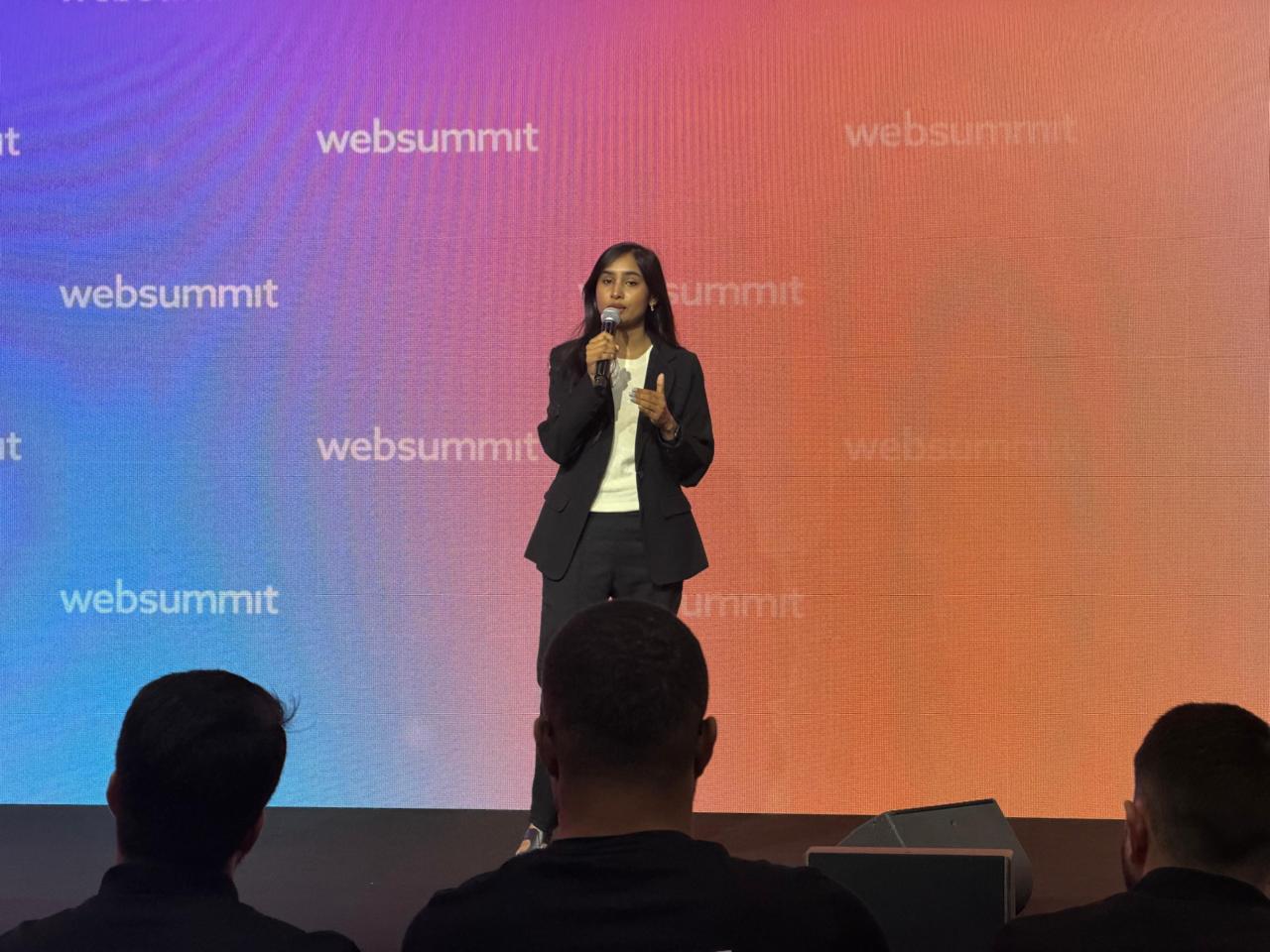
A key highlight of every Web Summit edition is the Startup Showcase — a dedicated platform where selected companies present their vision and technology directly to investors, partners, and global media. At Web Summit Qatar 2026, Ting Ting’s Director of Engineering, Anjelika Sah, took the stage at the Startup Showcase to present the company’s technology and its global expansion roadmap.
The presentation covered Ting Ting’s core platform capabilities — how the RIRI voice engine manages thousands of simultaneous customer interactions across voice and text, how the Understanding Engine interprets complex Nepali language at enterprise scale, and how the company plans to expand these capabilities into other regional and international languages. Additionally, the presentation highlighted Ting Ting’s proven deployments in Nepal as validation that its technology works at scale in production environments — not just in controlled demonstrations.
International Interest in Localized AI
The response at Web Summit Qatar 2026 was significant. International partners and investors showed considerable interest in Ting Ting’s localized AI approach — specifically its ability to operate effectively in complex, low-resource linguistic environments. This interest reflects a broader global trend. As AI adoption expands beyond English-speaking markets, the demand for AI systems that genuinely understand regional languages, cultural contexts, and local communication patterns grows rapidly.
Ting Ting’s position — having already solved this problem for Nepali — gives it a credible foundation to expand into other underserved linguistic markets. The conversations generated at Web Summit Qatar consequently opened doors to international partnerships that would otherwise take years of cold outreach to establish.
Why This Achievement Matters for Nepal
Nepal’s First Solo Startup at a Global Tier-One Event
To understand the significance of Ting Ting’s Web Summit Qatar appearance, consider the context. Nepal’s technology startup ecosystem remains relatively young. Access to international venture capital is limited. The country lacks the established startup infrastructure — accelerators, angel networks, deep technical talent pools — that mature ecosystems in India, Singapore, or the United States take for granted.
Against this backdrop, a Nepali startup being selected as the sole representative from the country at a global event alongside 1,600 startups from 120 nations is not a minor achievement. It demonstrates that technical excellence — built with purpose and without shortcuts — can compete globally regardless of geography.
Proving That Nepali AI Can Compete
Ting Ting’s core technology addresses one of the hardest problems in applied AI — making language models work accurately in low-resource, morphologically complex languages. Nepali presents specific challenges that standard English-centric AI models handle poorly — tonal variation, complex honorific structures, and a relatively small corpus of digitized training data. Building a system that overcomes these challenges and then deploying it at enterprise scale across banks, ISPs, and government bodies is a genuine technical accomplishment.
As a result, Ting Ting’s success at Web Summit Qatar demonstrates not just that a Nepali company can attend a global conference — but that Nepal can produce AI technology sophisticated enough to attract serious international investor attention in its own right.
A Signal for Nepal’s Startup Ecosystem
Furthermore, Ting Ting’s achievement sends an important signal to Nepal’s broader startup community. It shows that the path to global recognition is available — even for companies operating in a small, landlocked market with limited access to traditional startup resources. Moreover, Ting Ting’s “Made in Nepal, for the world” philosophy provides a replicable model — solve a hard problem locally first, prove it at scale domestically, and then take that proven solution global.
What Comes Next for Ting Ting?
Expanding Beyond Nepali
At the Startup Showcase, Ting Ting revealed its ongoing work expanding the platform into other regional and international languages. While the Nepali language implementation is already production-ready, the company’s ambition extends to serving other low-resource language markets globally — markets where the same problems of linguistic complexity and limited AI training data apply. Consequently, the technology Ting Ting built for Nepal has direct applicability across dozens of similar linguistic environments across South Asia, Southeast Asia, and beyond.
A Unified Communication Platform
Additionally, Ting Ting has previewed its upcoming unified communication platform — merging text, voice, forms, and AI agents into one intelligent ecosystem. This evolution takes the company beyond standalone voice telephony into a comprehensive AI-powered communication suite for enterprises. For Nepal’s businesses and institutions already using Ting Ting’s current products, this platform represents a significant expansion of capability. For international markets, it positions Ting Ting as a full-stack AI communication partner rather than a point solution.
Global Partnerships on the Horizon
The connections made at Web Summit Qatar 2026 are expected to translate into formal international partnerships over the coming months. While Ting Ting has not yet publicly announced specific global partnerships arising from the summit, the level of investor and partner interest generated at the event strongly suggests that the company’s next phase involves international deployment — taking Nepali-built AI to markets far beyond the Himalayas.
The Broader Picture — Nepal’s Tech Startup Ecosystem in 2026
Ting Ting’s Web Summit Qatar achievement does not exist in isolation. It reflects a broader maturation of Nepal’s technology startup ecosystem — one that has quietly been building momentum over the past five years. Companies across fintech, edtech, agritech, and now AI are emerging from Nepal with solutions that address real problems at meaningful scale.
Nevertheless, significant challenges remain. Access to early-stage funding continues to limit how quickly Nepali startups can scale. The brain drain — talented engineers and entrepreneurs leaving for opportunities abroad — remains a persistent structural issue. Regulatory frameworks for tech startups in Nepal are still evolving. However, moments like Ting Ting at Web Summit Qatar demonstrate that these challenges are not insurmountable — and that Nepali founders who commit to building world-class technology can earn their place on the global stage.
FAQ
Ting Ting is a Nepali AI-powered business communication company that builds enterprise voice and text communication systems using its proprietary RIRI voice engine and Understanding Engine — both developed entirely in Nepal. The company operates under a “Made in Nepal, for the world” philosophy and has deployed its systems across major banks, ISPs, and government institutions in Nepal.
Web Summit Qatar is one of the world’s most prestigious technology conferences, held annually in Doha. The 2026 edition brought together over 1,600 startups from 120 countries, more than 700 international investors, and companies collectively representing over USD 463 billion in lifetime funding. Participation requires a rigorous global vetting process.
Ting Ting was selected following a rigorous global vetting process based on the technical sophistication of its RIRI voice engine and Understanding Engine — AI systems built and trained entirely in Nepal. The company’s proven enterprise deployments across banks, ISPs, and government institutions further validated its credentials for selection.
Ting Ting’s Director of Engineering, Anjelika Sah, presented the company’s vision and technology at the Startup Showcase — one of the main platforms of the summit where selected companies present to international investors and partners.
Ting Ting uses two core proprietary systems — the RIRI voice engine for real-time AI-powered voice communication and the Understanding Engine for interpreting intent, context, and language nuance across simultaneous interactions.
Closing
Ting Ting’s appearance at Web Summit Qatar 2026 as Nepal’s sole startup representative is more than a company milestone. It is a statement about what Nepal’s technology sector is capable of when it commits to building with ambition and technical rigour. Founded less than a year before its global debut, Ting Ting earned its place among 1,600 startups from 120 nations — not through connections or capital, but through the quality of technology built entirely in Nepal.
For Nepal’s growing community of founders, engineers, and technology entrepreneurs, this achievement is both an inspiration and a proof of concept. The world is paying attention to localized AI. Nepal has something genuinely valuable to offer. And Ting Ting has just shown that the path from Kathmandu to the global stage is shorter than many believed.