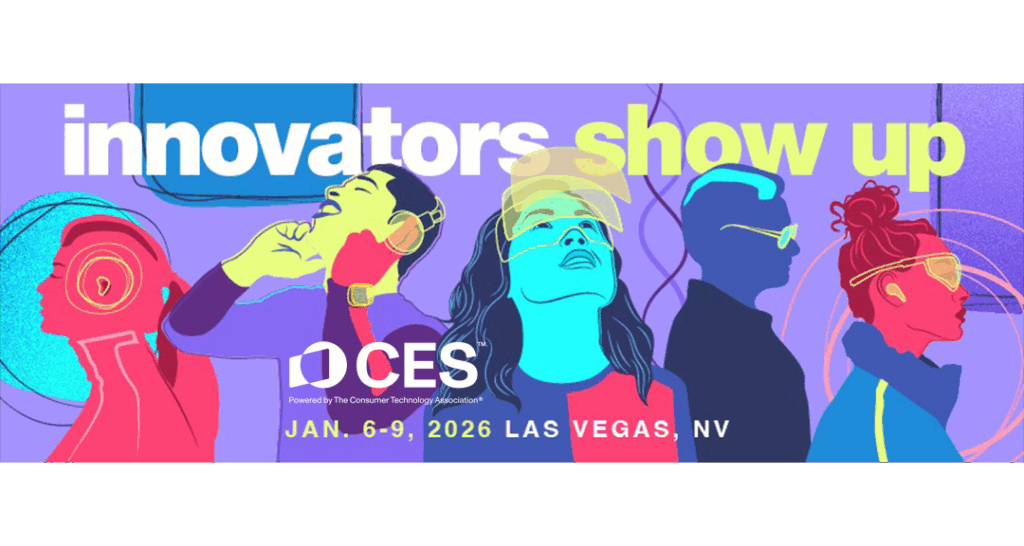
LAS VEGAS: CES 2026 officially opened Tuesday, bringing together global innovators, industry leaders, policymakers, investors, and media in Las Vegas. The four-day event highlights the technologies expected to shape industries and daily life in the years ahead.
Organized by the Consumer Technology Association (CTA), CES 2026 spans more than 2.6 million net square feet across 13 venues. Notably, the show includes the newly renovated Las Vegas Convention Center (LVCC) and runs through Friday, January 9.
This year, more than 4,100 exhibitors are participating. They range from established global brands to early-stage startups. Together, they are showcasing innovation across artificial intelligence, digital health, accessibility, energy, enterprise solutions, immersive entertainment, mobility, quantum computing, and robotics.
Media Days Set the Stage
Ahead of the official opening, CES hosted two Media Days on January 4 and 5. During this period, companies announced new products, partnerships, and technologies through press events and live demonstrations.
Meanwhile, CES 2026 marks the first major event to fully utilize the completed $600 million renovation of the LVCC. As a result, the upgraded campus significantly expands exhibition and meeting capacity.
“CES is where innovators show up, business accelerates, and partnerships ignite,” said Gary Shapiro, Executive Chair and CEO of CTA. He added that technology showcased this week is designed to solve real-world challenges.
Similarly, CTA President Kinsey Fabrizio said CES brings together the entire technology ecosystem. According to Fabrizio, the event helps innovation move from concept to impact.
Industry Leaders Emphasize AI
During CTA’s State of the Industry Address, Shapiro and Fabrizio highlighted the growing influence of artificial intelligence. In particular, they noted that CES remains the proving ground where emerging technologies reach practical deployment.
As technology adoption accelerates, CES continues to play a key role in connecting innovation with real-world applications.
Keynotes Spotlight AI and Industrial Transformation
AMD
AMD Chair and CEO Dr. Lisa Su outlined how the company’s AI portfolio is delivering measurable results across industries. During her keynote, AMD introduced the Ryzen AI 400 Series for next-generation AI PCs and the MI440X GPU for enterprise workloads.
In addition, AMD unveiled the Ryzen AI Halo developer platform. Su also announced a $150 million investment aimed at expanding AI education in classrooms and communities. Later, Michael Kratsios, the U.S. President’s Science and Technology Advisor, joined the discussion to address public-private collaboration.
Siemens
Meanwhile, Siemens AG President and CEO Roland Busch presented new technologies focused on accelerating the industrial AI revolution. He was joined on stage by NVIDIA CEO Jensen Huang, as both companies expanded their partnership.
Furthermore, Siemens introduced Digital Twin Composer, a platform designed to enable large-scale industrial simulation. Company leaders explained that the technology can improve efficiency in manufacturing, infrastructure, and mobility.
Press Conferences and CES Unveiled Drive Early Attention
Throughout Media Days, press conferences at Mandalay Bay featured announcements from companies such as Bosch, Geely Auto Group, Hisense, Hyundai, LG Electronics, Sony Honda Mobility, and The LEGO Group.
At the same time, CES Unveiled Las Vegas, the official press preview event, showcased innovations from more than 225 companies. These included wearable health devices, robotic exoskeletons, AI-powered productivity tools, and electric mobility solutions.
Tech Trends, Awards, and Sustainability Efforts
Additionally, CTA’s Tech Trends to Watch presentation outlined how AI is driving personalization and improving digital health solutions. According to CTA’s latest forecast, the U.S. consumer technology industry is expected to reach $565 billion in revenue in 2026, reflecting 3.7% year-over-year growth.
Beyond technology showcases, CTA announced $125,000 in funding through the CES 2026 Green Grants program. These funds will support sustainability projects in Las Vegas, including urban tree planting and energy-efficient street lighting.
Moreover, CES 2026 features a record number of CES Innovation Awards® honorees. Select winning products are on display at the Innovation Awards Showcase at the Venetian.
Expanded Programming and New Communities
This year’s event includes more than 400 conference sessions across tracks such as Digital Health, Accessibility, Manufacturing, Innovation Policy, C Space®, and Great Minds. In total, more than 1,300 speakers are participating throughout the week.
In addition, CTA introduced CES Foundry, a new community focused on AI and quantum technologies. The program opens January 7 at the Fontainebleau with two days of demos, discussions, and networking.
Conclusion
Overall, the opening of CES 2026 highlights how quickly technology is moving from experimentation to real-world use. With artificial intelligence, digital health, mobility, and sustainability taking center stage, the event reflects the direction of global innovation.
As a result, technologies unveiled this week are expected to influence markets worldwide over the coming months. For emerging economies such as Nepal and the broader South Asian region, CES 2026 provides early insight into trends that may soon shape consumer technology, business adoption, and digital infrastructure.
CES 2026 continues through January 9 in Las Vegas, setting the tone for the year ahead in global technology.